
Context Engineering vs Prompt Engineering: Key Differences
A support assistant gives the wrong refund deadline. Should you rewrite its instructions or fix the policy text it receives? Editing the prompt is cheap to try. Repeating that edit without checking the evidence wastes time and can hide the cause.
Run a small test before changing the workflow. Keep the question fixed, then give the model a short, current policy excerpt that contains the answer. If it now gets the deadline right, inspect how your system selects and passes source material. If it still fails, test clearer instructions for reading the policy and citing the rule.
| Test result | First change to test |
|---|---|
| Correct fact, wrong format or tone | Revise the prompt’s output rules |
| Correct answer only with the policy excerpt | Check retrieval and source freshness |
| Correct answer with a short excerpt, failure with the full file | Remove irrelevant text and check source order |
| Failure even with clear instructions and the right excerpt | Check model capability and task difficulty |
Context engineering vs prompt engineering is a question of where to intervene in one pipeline: wording controls behavior; context supplies evidence.
Start with the smallest change you can test. A clearer instruction costs less to maintain than a retrieval pipeline. A maintained source pipeline earns that cost when answers depend on changing facts.
Table of Contents
- Why the Two Terms Get Confused
- Defining Prompt Engineering and Context Engineering
- Comparing Goals, Techniques, and Success Metrics
- How Context Rot Limits the Power of More Tokens
- Workflows From Prompt Iteration to Context Pipelines
- Use Cases and Recommendations for Each Situation
- Putting a Question-First Prompt to Work Today
Why the Two Terms Get Confused
Both disciplines end in the same place: text that reaches the model. A role line, a retrieved passage, a tool result, and a chat history all arrive as tokens in one input. When the answer improves, the interface gives no clue which edit caused it. A sharper constraint can look like better evidence; a cleaner excerpt can look like better wording.
The confusion also comes from packaging. Prompt libraries include examples and background notes. RAG demos are often sold as prompt tricks. Agent setups fold instructions, memory, and tool output into a single template. From the outside, all of it gets called prompting.
Use a narrower test. Hold the evidence fixed and change only the instruction. If the answer moves toward the target, wording was the weak layer. Hold the instruction fixed and swap the supplied material. If accuracy changes, the context was the weak layer. If neither change helps, check whether the model can reach the needed source or tool at all.
Practical rule: diagnose the input, not the mood of the answer.
This is why rewrites stall. I have seen a policy question keep failing after careful phrasing because the cited clause never reached the context window. I have also seen retrieval added to a task that only needed a tighter output format. Same symptom, different repair.
Defining Prompt Engineering and Context Engineering
Prompt engineering is the craft of wording and structuring a request so a model responds as intended. A prompt can define a role, state a task, set constraints, provide examples, and specify an output format. Clear instructions help a model separate what it must do from what a good answer looks like.
The discipline grew up in public. As generative AI spread, practitioners began publishing and sharing prompt collections, and techniques like chain-of-thought prompting (asking the model to write out intermediate steps before answering) showed that a designed instruction could reliably change how a model reasons. What started as trial and error became a repeatable method.
Context engineering is the design of the full information environment a model sees at generation time: the prompt, system instructions, conversation history, retrieved documents, tool outputs, memory, and other runtime state. The work is deciding what information the model needs, how to assemble it, and how to present it. This guide to context engineering in AI covers that wider layer in detail.
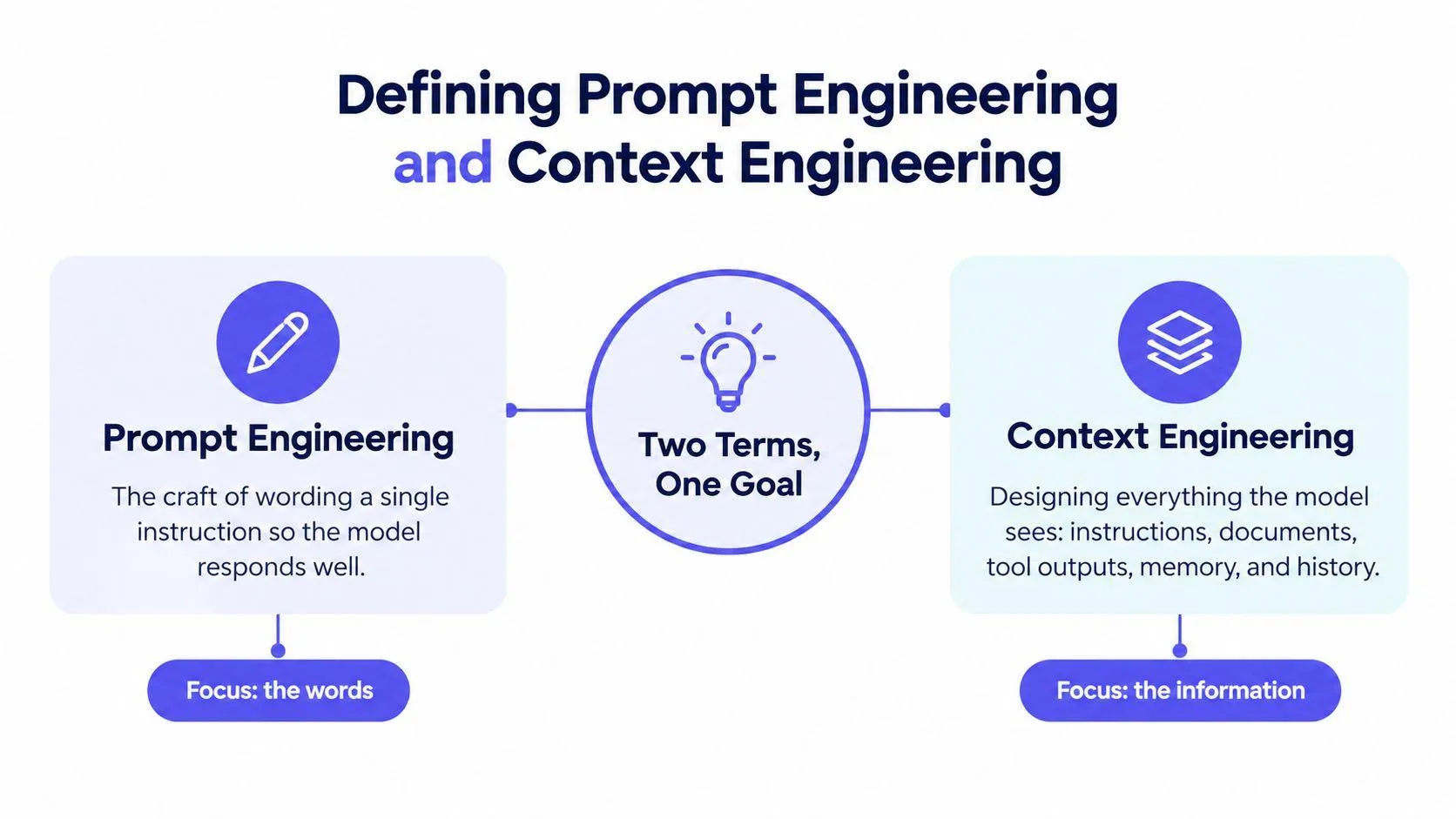
Put plainly: prompt engineering controls how you ask, and context engineering controls what the model can draw on. They meet inside a single call. Get the first wrong and the model does the wrong task well. Get the second wrong and it does the right task on weak evidence.
Comparing Goals, Techniques, and Success Metrics
The difference becomes practical when you compare what each discipline controls, what teams change, and what they count as success.
| Criterion | Prompt Engineering | Context Engineering |
|---|---|---|
| Primary control point | The instruction and examples in a model call | The information, tools, and state assembled for the call |
| What gets optimized | Clarity, task framing, constraints, and output format | Relevance, authority, coverage, ordering, and freshness of evidence |
| Typical techniques | Role assignment, examples, explicit rules, format instructions | Retrieval, filtering, ranking, memory, tool orchestration, compression |
| Typical artifact | A reusable prompt or instruction template | A context pipeline or assembly process |
| Common failure mode | Ambiguous or conflicting instructions | Missing, irrelevant, stale, or poorly ordered context |
| How success is measured | Whether the requested output is clear and useful | Context-selection recall and precision, grounded-answer accuracy, citation correctness, latency, input-token volume, and cost per successful task |
A better-written prompt should improve the response to a defined task. A better context pipeline should help the model use the right information. That difference matters because good prose is a poor substitute for reliable retrieval, and a large document collection doesn’t tell the model how to answer.
There’s no settled universal verdict on which discipline produces better results. A 2026 scholarly comparison reports evidence for individual mechanisms such as retrieval, tools, memory, and long-context processing, but no standardized end-to-end benchmarks that cleanly separate orchestration quality from base-model capability. Claims that context engineering always outperforms prompt engineering therefore aren’t established by the available comparisons.
For a useful test, hold the model and task set constant. Start with a prompt-only baseline, then add retrieval, filtering, memory, or compression one stage at a time. Track the metric that matches the failure: output quality for unclear instructions, grounded accuracy for evidence, or context-selection precision when irrelevant material crowds the answer.
How Context Rot Limits the Power of More Tokens
A model can accept a long input and still miss the passage that answers the question. The context window sets an input limit. It does not guarantee equal use of every token inside it.
Context rot describes declining reliability as context grows. Extra material can introduce distractions, conflicting claims, and stale instructions. Even relevant evidence can become harder to use when buried among other passages. In Lost in the Middle, researchers found that models often performed better when relevant information appeared near the beginning or end of an input, with worse results when it appeared in the middle. The size of that effect varied by model and task.
There is no universal token count at which accuracy collapses.
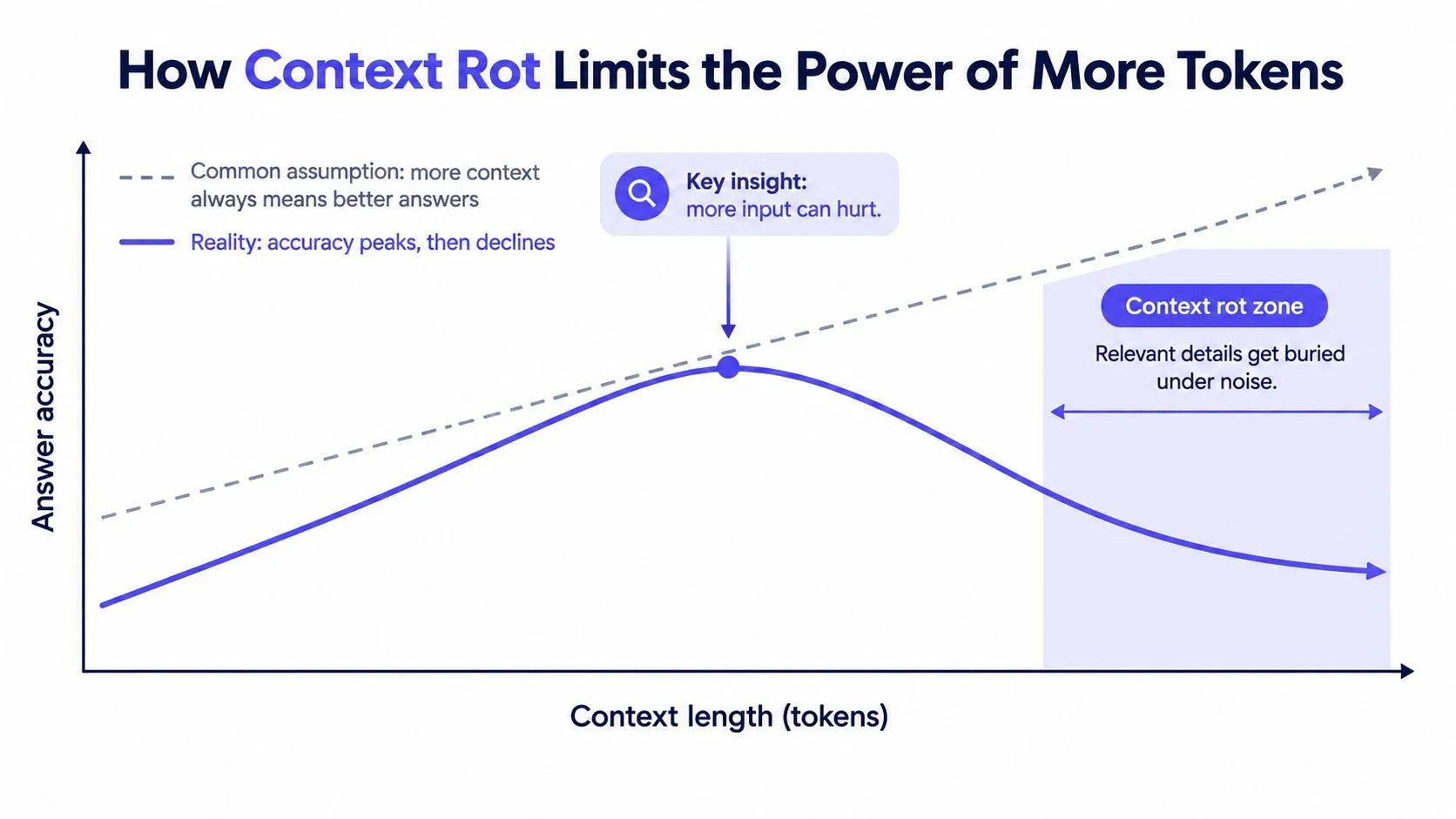
Adding context helps when it supplies missing evidence. Once the answer is supported, adding loosely related documents can increase cost and latency while giving the model more competing material to resolve. Whether accuracy falls depends on the model, the task, and how the evidence is arranged.
Consider a support assistant that gives the wrong refund deadline. The current policy says 30 days, but the input also contains an expired 60-day policy and a long conversation about shipping. Use a controlled test to locate the failure:
- Provide only the current policy, keeping the prompt unchanged. If the answer improves, examine which sources entered the context and how their authority was marked.
- Keep that same policy and clarify the instruction. Ask the assistant to cite the active refund rule and distinguish it from shipping rules. Improvement here points to a behavior problem.
- Restore the longer input. If the error returns, test document position and remove competing passages before adding more instructions.
Chunk size creates a related trade-off. Small chunks can separate a rule from its exceptions; large chunks can carry unrelated text into the answer. Preserve enough surrounding text to interpret the evidence, then test whether the model uses it correctly.
Prompt wording controls how the assistant answers. Context controls which evidence it can use. A useful diagnosis checks both within the same pipeline, changing one at a time.
Workflows From Prompt Iteration to Context Pipelines
Prompt work often happens in a tight loop: draft the request, run it, read the result, change the wording, and run it again. That loop can help when the task or output contract isn’t clear. The editing-session figures cited earlier show why repeatedly refining text can also consume substantial time.
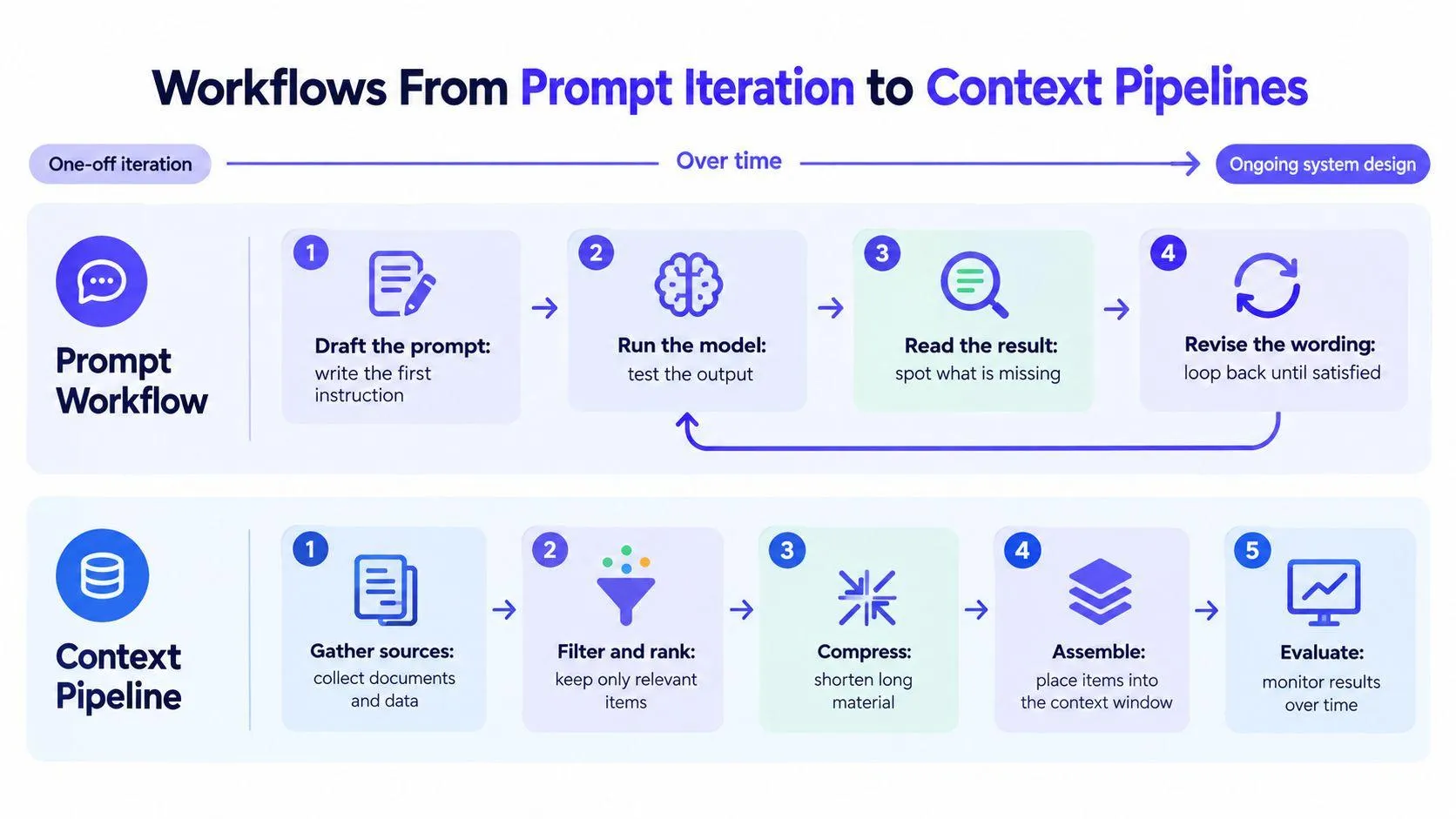
A context pipeline follows a different sequence. The system identifies relevant sources, retrieves material, filters noise, labels authority, orders what remains, compresses older history, and assembles the result for the model. If the model uses a tool, its output can become part of the next turn’s context.
OpenAI’s tool documentation and model specification describe tools as programs an assistant can call for specific tasks. The available mechanisms include built-in tools, function calling, programmatic tool calling, tool search, and remote MCP servers. A file-retrieval tool that supplies the relevant company-policy text is more reliable than asking a model to recall that policy from memory. A function that calculates an order total is a better fit than asking the model to do arithmetic in prose.
A prompt can tell the model how to retrieve, summarize, and format. It can’t return a document or function result the system never made available.
The workflows meet at the model call. Instructions still define the task, retrieval rules, summary behavior, and output format. Context engineering supplies the source material and capabilities those instructions depend on. When a system fails, trace the path: Was the instruction unclear, was the right source missing, or did the pipeline pass too much? Fix the step that broke, not the entire system by default.
Use Cases and Recommendations for Each Situation
Choose the fix based on what the task needs and what the model got wrong. A one-off marketing email or social post usually needs a clear audience, tone, purpose, and format. When the model has enough information already, prompt engineering does most of the work.
Summarizing a long report is different. The request might be perfectly clear, but the answer can still suffer if the relevant passages are buried or the input is too long. Organize the source material, select the parts that support the requested summary, and set rules for what to retain.
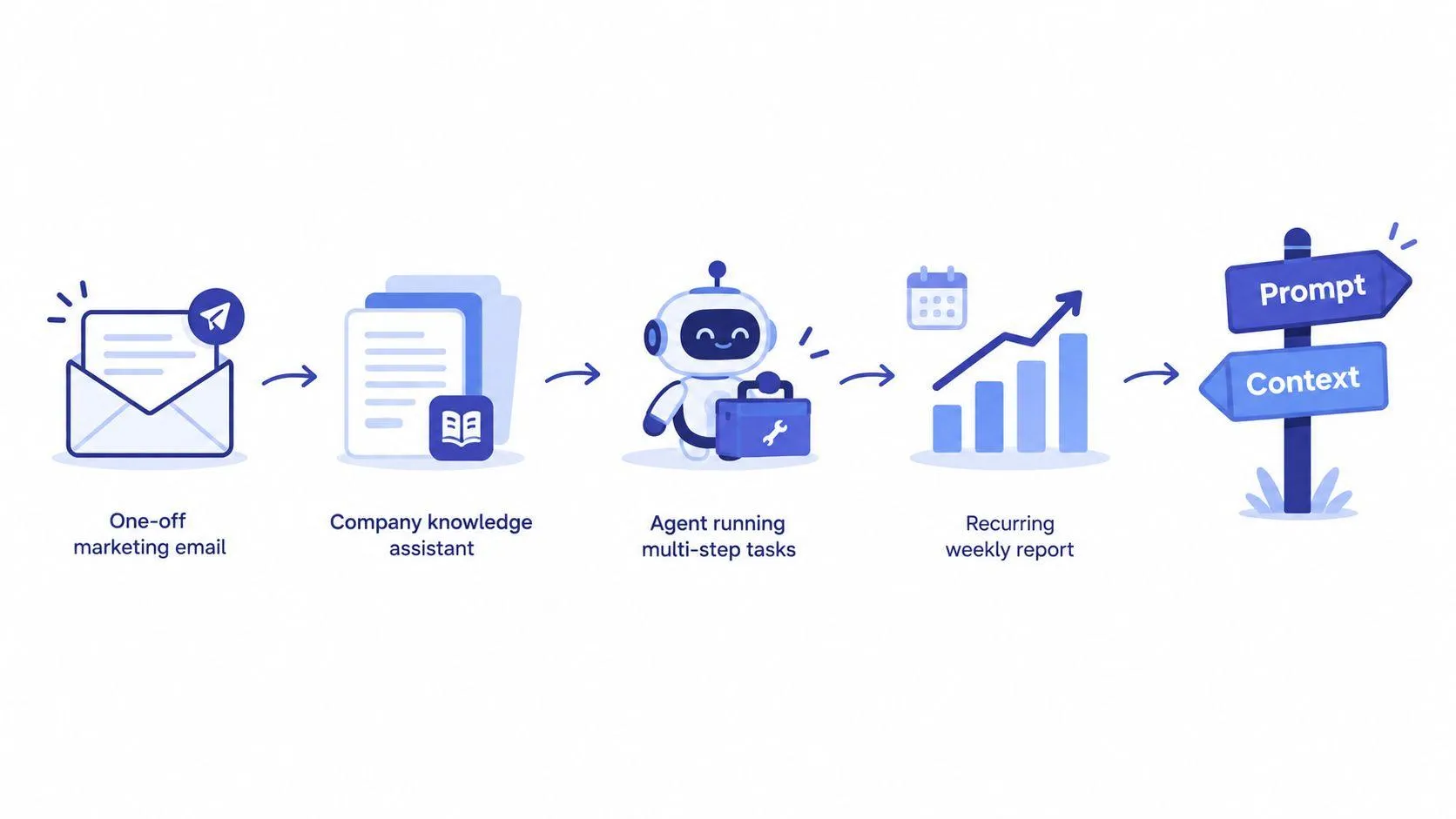
An internal assistant that answers questions from company policies needs more than polished instructions. It needs access to current, authoritative policy documents, along with a way to retrieve the relevant passages for each question. In that case, context engineering does most of the work; the prompt still defines how the assistant should answer and handle uncertainty.
Coding agents show the same split. ContextBench contains 1,136 issue-resolution tasks from 66 repositories across eight programming languages, with human-annotated gold contexts. Its findings indicate that agent scaffolding yields only marginal gains in context retrieval, and that there’s a substantial gap between the context agents explore and the context they use (ContextBench findings). An agent can inspect many files yet still fail to include the useful ones in the final working context.
Use this decision rule:
- Revise the prompt when the request is vague, the audience is unclear, or the output format is wrong.
- Change the context when the model lacks evidence, receives stale or irrelevant material, or can’t use the available sources effectively.
- Start with prompting for single-shot tasks.
- Invest in context engineering when the same knowledge must support repeated calls or a multistep workflow.
A prompt isn’t a retrieval system. A retrieval system isn’t a substitute for a clear task. Start with the simpler layer, then switch when the failure points to the other one.
Putting a Question-First Prompt to Work Today
Take a weak customer-update draft. Before rewriting it, ask what the model needed to know: Who will read it? What changed? Which facts can it cite? What should the reader do next? Those questions separate missing instructions from missing evidence before you spend another round polishing the wording.
Prompt Like A Pro offers a question-first route to a structured prompt, helping you spell out the audience, format, and constraints. Use that step to define the task. Supply the source material separately, and check the tool’s current privacy terms before entering sensitive content. The prompt-engineering tips guide covers ways to make those instructions clearer.
Then run a controlled comparison:
- Keep the evidence fixed. Run the original prompt and the revised prompt against the same source material, using the same model and settings.
- Check behavior. Compare the audience fit, required format, and requested action. A more polished tone alone does not prove the revision worked.
- Test the evidence layer. Keep the revised prompt, replace stale or irrelevant material with the right source passages, and check factual accuracy again.
For the customer update, a useful instruction might be: “Use only the attached release notes. Separate confirmed changes from open questions. If a date is missing, flag it rather than infer it.”
That instruction controls behavior; the release notes supply evidence.
Keep the version that fixes the observed failure. Better wording costs little to test. Better retrieval takes more work, but earns that cost when repeated answers depend on changing sources.
Ready-made prompts for this
Build yours with the wizard
Prompt Like A Pro asks a few questions about your task, then writes a complete prompt for ChatGPT, Claude or Gemini. Free, no signup.
Make a prompt →Read next
How to Master AI Prompt Optimization
How to optimize AI prompts without guessing: a testable brief, Orwell-style rewrites, controlled experiments, reliability checks and a routine you will actually use.
Read the guide →