
What Is Context Engineering in AI and Why It Beats Prompts
Context engineering is the practice of giving an AI every relevant detail about audience, goal, format, tone, and constraints before it answers. A bare prompt leaves the model to guess, and that is why the reply sounds safe, vague, and easy to ignore.
You’ve probably seen it yourself. You ask for a post, an email, or a summary, and the result sounds polished but says almost nothing useful. The problem usually isn’t the model. It’s the missing context.
Table of Contents
- Why Your AI Replies Sound Generic
- What Context Engineering Actually Means
- The Building Blocks of Good Context
- A Vague Prompt Versus a Context-Rich One
- The Misconceptions That Keep People Stuck
- How Prompt Like A Pro Implements It
- A Five-Item Checklist Before You Send
Why Your AI Replies Sound Generic
A marketing manager types, “write a LinkedIn post about our scheduling app.” The chatbot returns something clean enough, but it talks in broad terms about productivity, time savings, and modern work. It could fit any software company, which means the manager still has to rewrite most of it.
Now the same manager adds a few details. The app is for dog groomers. The audience is small salon owners who hate phone tag. The tone should be friendly, not corporate, and the post should end with a question. The reply changes fast, because the model no longer has to fill in the blanks.
That gap is the whole point. Generic input creates generic output, and the fix is not clever phrasing. It’s better context. Microsoft’s guidance makes the same practical point, give background, define the goal, specify the format, and cut ambiguity so the model has less to interpret Microsoft’s prompt engineering guidance.
Practical rule: if you would have to edit the answer heavily, the prompt probably hid too much.
A good system gives the model a cleaner brief before it writes. That usually means naming the audience, the task, the limits, and what a good result looks like. Tools like Strip Predictable Patterns from AI-Generated Writing exist because people keep hitting the same wall, bland output from thin input.
The rest of this guide breaks the habit into a simple framework: who the reader is, what success looks like, what format is needed, what constraints matter, and what tone to use. Once those pieces are in place, the model stops guessing and starts producing something you can use.
What Context Engineering Actually Means
Context engineering is the deliberate practice of packaging the information an AI needs before it answers. The request itself can stay short. What changes is the brief around it, who it’s for, what it should do, how it should look, and what it should avoid.
That is different from a generic prompt. A generic prompt is a single line like “write me a marketing email.” Context engineering turns that into a shaped task. You might say the audience is first-time buyers, the goal is to book a demo, the tone is plain, the length is short, and the message must avoid buzzwords. The model now has fewer gaps to fill on its own.
Anthropic describes context as the tokens included when sampling from an LLM, and frames context engineering as optimizing those tokens during inference Anthropic’s guidance on effective context engineering for AI agents. That matters because modern systems often need prompts, tool definitions, retrieved documents, memory, and conversation history all at once. In that setting, the question is not only what the prompt says, but what the model sees, in what order, and in what form.
A simple way to think about it
Prompt engineering focuses on wording. Context engineering focuses on the information environment around the wording. The first tries to sharpen the sentence. The second tries to make the whole task legible.
A plain prompt with the right details beats a fancy one with none.
Take the scheduling app again. A bare request asks for a LinkedIn post. A context-rich request says the audience is operations directors at mid-sized SaaS firms, the goal is demo sign-ups, the format is a 90-word post with a hook and one call to action, and the tone is direct without buzzwords. The output improves because the model can now aim at one result instead of five possible ones.
That shift is why many practitioners now treat context engineering as a separate discipline. The model is not being asked to be smarter. It is being given a better frame for deciding what to say.
The Building Blocks of Good Context
Good context is not a pile of extra words. It is a set of clear blocks that help the model decide what matters first. A simple audit is to check whether a prompt names the audience, the goal, the format, the tone, the constraints, and the success criteria.
| Block | What it tells the AI | Example for a LinkedIn post |
|---|---|---|
| Audience | Who the message is for | Operations directors at mid-sized SaaS firms |
| Goal | What the output should achieve | Drive demo sign-ups |
| Format | How the answer should be shaped | 90 words, one hook, one call to action |
| Tone | How it should sound | Direct, plain, no buzzwords |
| Constraints | What to avoid or limit | No jargon, no emoji, no invented stats |
| Success criteria | What a good result must include | Names the pain point and ends with a question |
Audience matters because it stops the model from guessing at the reader’s role or skill level. Goal matters because a reply can only do one thing well at a time. Format matters because the model needs to know whether you want a post, a memo, a summary, or a script.
Tone, constraints, and success criteria make the output usable. Tone keeps the voice steady. Constraints block filler and mistakes. Success criteria define what “good” means for this task, which is more useful than asking the model to sound smart.
The structured roles described in the literature point to the same habit, just with different labels, such as authority, exemplar, constraint, rubric, and metadata structured context roles in the literature. If the prompt includes retrieved material, structure that input too. For a worked example of structuring retrieved material, see design a retrieval-augmented generation architecture.
In short: audience, goal, format, tone, constraints, and success criteria are the six blocks worth checking before every prompt.
Prompt Like A Pro uses this habit in a practical way. It gives you a free way to shape context before you send a prompt, without asking you to create an account first. That makes the idea easier to use in real work, where speed matters and vague instructions waste time.
A Vague Prompt Versus a Context-Rich One
A bare prompt looks easy. It is also the fastest way to get a forgettable reply. “Write a LinkedIn post about a new scheduling app” gives the model almost nothing to work with, so it writes something generic, safe, and easy to skim past.
Add context and the output changes. The audience is operations managers at mid-size companies. The goal is demo signups. The format is 150 words, three short paragraphs, one link in the comments. The tone is professional but conversational, with no jargon and no claims about competitors. That same request now has shape.
| Element | Bare Prompt | Context-Rich Prompt |
|---|---|---|
| Task | Write a LinkedIn post about a new scheduling app | Write a LinkedIn post about a scheduling app for operations managers |
| Audience | Not stated | Operations managers at mid-size companies |
| Goal | Not stated | Drive demo signups |
| Format | Not stated | 150 words, three short paragraphs, one link in comments |
| Tone | Not stated | Professional but conversational |
| Constraints | Not stated | No jargon, no competitor claims, end with a soft CTA |
The difference shows up in the edit time. The bare version forces you to fix the angle, the voice, the length, and the call to action. The context-rich version usually needs only a light polish because the model already knew what kind of answer to build.
If you want a quick boundary test, ask yourself whether the output would still work if it were pasted into a random company’s feed. If yes, the prompt was too thin. If no, the context is doing its job.
The 2025 survey of context engineering pulls together retrieval, processing, memory, and multi-agent systems, which shows why the field is broader than one prompt trick survey overview of context engineering. For day-to-day writing, though, the lesson stays simple. Give the model fewer reasons to guess, and it gives you fewer reasons to rewrite.
The Misconceptions That Keep People Stuck
The first myth is the magic words myth. People reach for phrases like “think step by step” or “be an expert” and expect the model to rescue a thin prompt. That rarely works, because a missing brief is still a missing brief.
The second myth is the act-as-an-expert trick. Telling the model to behave like a top marketer, lawyer, or doctor sounds strong, but it does not replace audience, format, or constraints. Without those, the answer still floats.
The third myth is that more text is always better. It isn’t. Dumping whole documents, old threads, or unrelated notes into the prompt can bury the useful parts. Good context is relevant context.
More text can drown the signal.
A better habit is plain and boring in the best way. Name the audience. State the goal. Set the format. Define success. Trim the rest. That is what gives the model a clear lane to stay in.
Newer production guidance also warns against treating summarization as the default fix for every context problem. A 2026 account argues that when prompt caching is in play, keeping the full context can be cheaper, faster, and more reliable than summarizing, and that compaction should respond to a real constraint rather than a habit production-focused account of context engineering tradeoffs. The point is not “always keep everything.” The point is to choose the right amount of context for the task.
How Prompt Like A Pro Implements It
Prompt Like A Pro turns this habit into a simple workflow. You start with a task in plain language, then it asks follow-up questions about audience, format, tone, length, and goal. Instead of forcing you to guess the right prompt shape, it pulls the missing details out of your head first.

The output is a structured prompt you can paste into ChatGPT, Claude, or Gemini. That matters because the tool is not trying to write the final answer for you. It is trying to shape the input so the model has a cleaner brief.
What the workflow does
The interface is built around questions first, not rewrites, and it runs in three steps. You describe the task and pick the AI tool you’re writing for (ChatGPT, Claude, Gemini, or any). You answer a few clarifying questions written for that specific task, skipping any you can’t answer. Then it writes the full prompt, ready to copy or open straight in ChatGPT, Claude, or Gemini, so a thin first description still ends up as a complete brief.
The service runs without an account and does not store prompts on its servers. That makes it easier to use for quick drafting, especially if you do not want to build a prompt from scratch every time.
If you’re choosing between tools, the useful test is simple. Does the tool help you collect the right context before the model writes? If it does, it’s serving the same practical goal as the methods in this article. Prompt Like A Pro does that by turning a vague ask into a structured prompt without asking you to learn the whole craft first.
Useful habit: ask the questions before you hit send.
A Five-Item Checklist Before You Send
Before you send any prompt, check five things. This takes seconds, and it keeps you from handing the model a vague job.
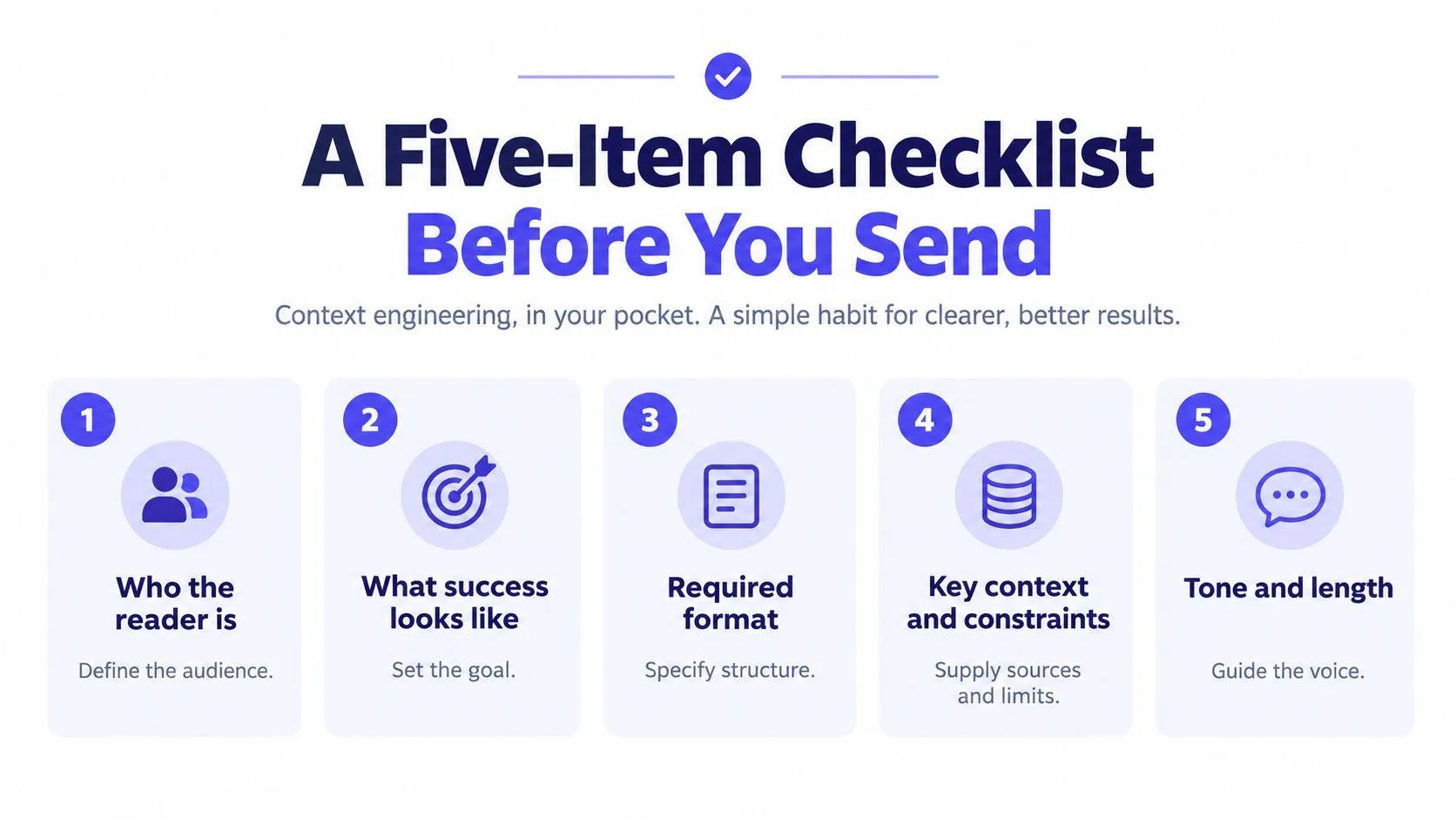
- Who the reader is. Name the audience in plain terms. If you skip this, the model will guess the level, role, and pain point.
- What success looks like. State the goal, not just the topic. A task can be about a product and still fail if it doesn’t persuade, inform, or move the next step.
- Required format. Say whether you want a post, email, summary, outline, or table. Structure changes the answer as much as subject matter does.
- Key context and constraints. Give the details the model must respect, plus the limits. That can include sources, length, banned phrases, or anything else that would make the answer unusable if missed.
- Tone and length. Choose the voice and keep the reply inside a sensible size. Plain, direct language usually beats ornate language when the goal is clarity.
Run the list before every send. If one box is empty, fill it in. If all five are covered, the model has a much better chance of giving you something close to done on the first pass.
Prompt Like A Pro helps you turn that checklist into a habit. It asks the missing questions, then builds a structured prompt you can use right away with the AI tool you already use. If you want a free way to apply context engineering without starting from a blank page, visit Prompt Like A Pro and try it on your next draft.
Build yours with the wizard
Prompt Like A Pro asks a few questions about your task, then writes a complete prompt for ChatGPT, Claude or Gemini. Free, no signup.
Make a prompt →