
Prompt Engineering vs Fine Tuning: Which Wins in 2026?
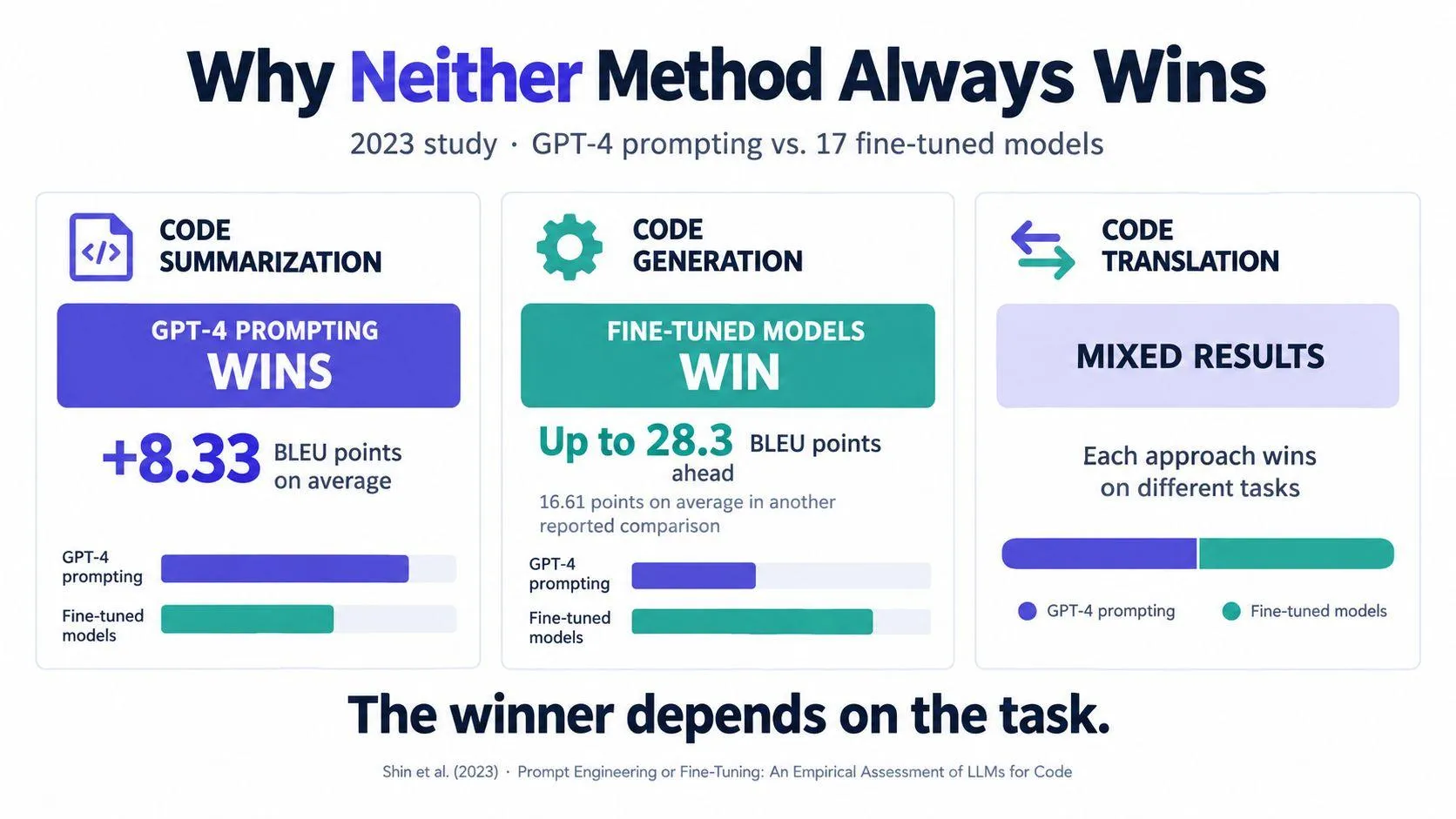
A 2023 study broke the usual debate open. GPT-4 prompt engineering beat the best fine-tuned model on code summarization by 8.33 BLEU points and on HumanEval by 8.59 points, yet fine-tuned models beat GPT-4 prompting on MBPP by 28.3 points. The lesson is blunt, prompt engineering vs fine tuning is not a contest with one winner, it’s an operational choice about which method meets your quality bar with the least friction. The study itself is the reason product teams should stop asking for a universal champion and start asking what changes fastest, what must stay stable, and what they can afford to maintain.
| Criterion | Prompt Engineering | Fine Tuning |
|---|---|---|
| Data needs | No labeled training set required | Needs task-specific examples |
| Cost profile | Low setup, ongoing token cost | Training, evaluation, and maintenance cost |
| Latency | Can stay light with short prompts | Often lighter at inference if prompts shrink |
| Reversibility | Easy to edit or roll back | Requires retraining and redeployment |
| Portability | Moves across major model providers | Tied to a specific base model and API |
Table of contents
- Why Neither Method Always Wins
- What Prompt Engineering and Fine Tuning Actually Change
- Five Criteria That Actually Drive the Decision
- The Hidden Trade-offs Most Comparisons Skip
- Which Picking One Approach Suits Your Real Scenario
- Fine Tuning Is Not One Thing
- Cost and Data Where You Should Spend Before Cutting
- A Decision Checklist You Can Apply Today
Why Neither Method Always Wins
The strongest mistake teams make is treating this as a single benchmark race. The 2023 comparison of GPT-4 prompt engineering with 17 fine-tuned models showed a split result, not a sweep. Prompting led on some code tasks, fine-tuning led on another, and the margin changed with the dataset and the benchmark design. That split comparison matters more than any one score because it shows the answer depends on the work in front of you.
Task shape matters more than ideology
A prompt that works for code summarization can still miss the mark on a code-generation benchmark. A fine-tuned model can look stronger on one dataset and weaker on another, even when the task family sounds similar. The practical question is which method is more reliable for your specific task, your data, and your release cycle.
Practical rule: if the task keeps changing, the cheaper mistake is usually a prompt edit, not a retrain.
The same 2023 comparison reported that basic prompting improved the leading baseline by only 1.34 percentage points on average. That is a warning against magical thinking. Better results came from task design and prompt quality, not from piling on more instructions.
The operational takeaway is simple. Use prompting when the task, domain, or output format is still moving. Treat fine-tuning as a candidate only when the task is stable, the failure mode is clear, and you can justify the extra training and maintenance work.
What Prompt Engineering and Fine Tuning Actually Change
Prompt engineering changes the input. Fine-tuning changes the model. That’s the whole distinction, and it’s worth keeping plain because product teams often blur it with slogans.
Input text versus model weights
With prompt engineering, you reshape the request through context, examples, constraints, and output format. You might ask for JSON instead of prose, add a small worked example, or specify a tone the model should follow. The model’s parameters stay frozen, so the behavior remains easy to revise.
Fine-tuning does something different. You train the model on task-specific examples so the desired behavior gets encoded into the weights. If you train on many labeled JSON examples, the model can learn to produce that structure without carrying a long instruction block every time. That makes the behavior more durable, but also more expensive to change later.
This guide shows the practical side of prompt shaping for developers who want cleaner outputs without retraining.
A useful mental model
Prompting is a conversation change. Fine-tuning is a model change. If your team keeps revising the goal, the conversation is the safer place to work. If the goal is fixed and repeated often, model-level specialization starts to make sense.
A prompt is easy to undo. A fine-tune becomes part of the deployment surface.
That difference matters in production. A prompt update ships quickly, and a bad version can be rolled back with little damage. A fine-tuned model brings more baggage, because the change lives inside the model artifact and has to be tracked, validated, and deployed like any other release.
Five Criteria That Actually Drive the Decision
The decision sits on five axes, and none of them is “does it score higher on a benchmark.” Teams need to look at data needs, cost, latency, reversibility, and portability together. If they optimize only one, they usually pay for it somewhere else.
Data needs and setup burden
Prompt engineering needs no labeled corpus to get started. That makes it the fastest option when the team has a vague task, a new model, or a moving target. Fine-tuning starts to make sense when the team can assemble representative examples and the task repeats often enough to justify that work.
Cost and latency
Prompting costs mostly live in iteration time and token usage. Fine-tuning shifts cost into training, validation, and maintenance, but it can reduce the amount of instruction text you send on every request. When a workflow runs constantly, those trade-offs matter more than abstract accuracy claims.
Reversibility and portability
A prompt edit is reversible. You can change one sentence and test again. A fine-tune is stickier, because the model has to be retrained or reissued if the behavior changes, and the team needs version control for the adapted checkpoint.
Portability cuts the same way. Prompts travel more easily across providers, including ChatGPT, Claude, and Gemini. A fine-tuned checkpoint binds you to the model family it was built on, which becomes a real problem when procurement, price, or model quality changes.
The comparison in one place
| Criterion | Prompt Engineering | Fine Tuning |
|---|---|---|
| Data needs | Works without labeled examples | Needs representative training data |
| Cost | Low setup cost, iterative testing | Higher upfront build and maintenance cost |
| Latency | Can stay efficient with tight prompts | Can reduce prompt size after training |
| Reversibility | Fast to edit and rollback | Slower to change, needs retraining |
| Portability | Easy to move across model providers | More tightly coupled to one base model |
Use prompting first when uncertainty is high. Move to training only when the pattern is stable enough to justify the lock-in.
The Hidden Trade-offs Most Comparisons Skip
Fine-tuning can change more than task quality. A Stanford fine-tuning safety evaluation showed that only 10 training examples and less than $0.20 in API charges were enough to compromise GPT-3.5 Turbo’s safety guardrails through fine-tuning. That should make teams much more cautious about third-party data, especially when the training set is small or lightly reviewed. the Stanford fine-tuning safety evaluation is a reminder that specialization can cut both ways.
Safety changes with the training set
A small fine-tune can shift behavior in ways the base model never showed. If the data is narrow, noisy, or drawn from sources you cannot fully inspect, the model may absorb unwanted behavior along with the intended pattern. That risk is easy to miss when the dashboard only tracks task accuracy.
Task dependence is the other hidden trade-off. A 2024 zero-shot vs fine-tuning classification comparison found that a carefully designed prompt reached an F1 score of 0.941 in its strongest configuration, with another prompt at 0.933, and concluded that zero-shot prompting could match or outperform one-shot prompting and fine-tuning on that classification task. the 2024 zero-shot vs fine-tuning classification comparison matters because the lighter method can be the better operational choice on a specific task.
Peak score is not the same as best decision
Teams often chase the best benchmark result because it looks easier to justify. In production, that can be the wrong target when the task keeps changing, the label set is thin, or the safety implications of the training data are unclear. A model that is slightly less accurate but easy to update can be the smarter choice.
For product work, the test is whether the system stays useful without constant repair. If the answer depends on unstable prompts, changing providers, or unclear labels, prompting often wins on operational control even when fine-tuning reports the cleaner score.
This walkthrough shows how a team evaluates a fine-tune against a strong baseline before committing.
Which Picking One Approach Suits Your Real Scenario
A solo marketer writing landing pages, ad copy, and research summaries usually gets more value from prompting. The work changes too often for training to pay back, and the model has to adapt to different formats every day. In that setting, the lowest-maintenance answer is a better prompt, not a new model.
A startup with a recurring extraction or classification task sits in the middle. If the same template runs hundreds of times a week and the team has a few hundred labeled examples, fine-tuning starts to justify a serious look. The gain comes from consistency, not from bragging rights.
An enterprise team handling sensitive documents has a different problem. If privacy constraints block outside processing or the task must behave the same way across repeated internal workflows, a private fine-tuned model or a PEFT setup becomes more attractive. The extra operational cost can be worth it when the workflow is stable and the error cost is high.
If the task changes weekly, keep the weights still. If the task barely changes, consider teaching the model the pattern once.
The contrast is not about company size. A small team can benefit from fine-tuning if it has enough repeated structure, and a large team can still do better with prompts if the use case is messy or shifting. What matters is repeatability, not prestige.
Fine Tuning Is Not One Thing
People talk about fine-tuning as if it always means rewriting the whole model. That’s outdated. The actual choice set includes full fine-tuning, LoRA, QLoRA, and prompt tuning, and those options sit at different points on the cost and control curve.
The spectrum matters
Full fine-tuning gives the most direct control, but it also brings the most storage, validation, and deployment burden. LoRA and QLoRA keep the base model frozen and train a smaller set of parameters, which is why they’ve become the practical middle ground for many teams. Prompt tuning sits closer to prompting because it learns a lightweight soft prompt instead of rewriting the full model.
A 2025 study on prompt tuning found that learned soft prompts matched or exceeded standard full-model tuning on SuperGLUE while using up to 27,000 times fewer task-specific parameters. That result doesn’t mean prompt tuning replaces all adaptation methods, but it does show that the parameter count alone doesn’t tell you which method is operationally smartest.
Choosing the lightest workable adaptation
If a team wants specialization without a large maintenance footprint, adapters are often the right place to start. If the task still changes often, structured prompting remains easier to edit and safer to reverse. Full fine-tuning belongs at the far end of the spectrum, where the task is stable, the data is solid, and the team can support a more rigid release process.
For teams that want a prompt-first workflow with stronger structure, Prompt Like A Pro offers a questions-first prompt generator and a prompt library that helps users build clearer prompts without training a model.
Cost and Data Where You Should Spend Before Cutting
The most expensive mistake is often training too soon. Fine-tuning requires labeled examples, compute, evaluation, and ongoing maintenance. Prompt engineering requires careful iteration, but it avoids the training pipeline entirely, which keeps the first round of experiments cheap and fast.
Data quality beats raw enthusiasm
A 2024 study found that specialized fine-tuned models often reached parity with, or exceeded, general models after only 100 to 1,000 labeled samples. That benchmark gives teams a practical threshold, but it doesn’t remove the need for representative labels. If the samples are narrow or unbalanced, the model can learn the wrong shape of the task.
Another 2025 IEEE study on immigration-law and insurance tasks found that LoRA and QLoRA delivered the best balance of parameter efficiency and task adaptation, and that fine-tuned open models could match or exceed larger general-purpose models. The study also showed that structured domains did better than more varied ones, which is exactly what product teams should expect.
Spend where the bottleneck lives
If your bottleneck is unclear instructions, spend on prompt structure. If your bottleneck is recurring, domain-specific behavior and you have enough representative examples, spend on adapters or fine-tuning. If the data is weak, the model will just learn the noise faster.
This prompt architecture guide is useful when a team wants to decide between prompting, retrieval, and fine-tuning without guessing.
A Decision Checklist You Can Apply Today
Start with the simplest question. Is the task still changing, or has it settled into a repeated pattern? If it’s still moving, prompting is usually the safer default because you can revise it without retraining anything.
Then ask whether you have labeled examples, and whether those examples are representative enough to teach the task rather than its exceptions. A few good samples can justify a test run. Thin or biased samples can justify staying with a prompt until the data improves.
Next, look at the cost of each error. If the output only needs to be “good enough,” prompt engineering can be enough. If one mistake creates a legal, financial, or safety problem, the bar is higher and the evaluation needs to be stricter.
Privacy changes the answer too. If data can’t leave a controlled environment, a local or private adapted model may be worth the operational load. If the task must work across changing providers, a prompt-based workflow stays much more portable.
Volume matters as well. A low-volume workflow rarely pays back training overhead. A repeated workflow with stable inputs can justify adaptation, especially when the prompt has become long and fragile.
Finally, ask how often the underlying model changes.
Ready-made prompts for this
Build yours with the wizard
Prompt Like A Pro asks a few questions about your task, then writes a complete prompt for ChatGPT, Claude or Gemini. Free, no signup.
Make a prompt →Read next
10 Midjourney Prompts Generator Tools Compared for 2026
Ten Midjourney prompt generators compared by the input you start with: a rough idea, a draft, or a reference image, with pricing and who each suits.
Read the guide →