
What Is Ad Copywriting? A Practical Beginner Guide
At 9 a.m., you open the brief, place the client notes on one side of the desk, and stare at a blinking Google Doc. The client wants clicks. Your manager wants conversions. You need to turn a vague offer into a few lines that make a stranger stop, understand, and act.
That pressure feels personal when the page is blank. It becomes manageable once you see ad copywriting as a measurable conversion craft, not as a mysterious talent reserved for people with naturally clever phrases.
Table of Contents
- What Ad Copywriting Actually Is
- How a Persuasive Ad Is Built
- Orwell’s Six Rules Applied to Ad Copy
- Ad Copy Formats Across Channels
- Why Specificity Beats Multiple Claims
- Beginner Templates You Can Fill In Today
- Measuring and Iterating Your Ads
What Ad Copywriting Actually Is
Ad copywriting is the practice of writing persuasive promotional text that prompts a measurable action. That action might be a click, lead, sign-up, booking, or purchase. The copy appears inside a paid placement, such as a search ad, social ad, display banner, video, or retail media listing.
A useful definition from this explanation of direct-response copywriting is practical rather than glamorous. Effective copy identifies a problem, makes a specific promise, supports that promise with proof, and explains what the reader should do next.
That makes ad copy different from nearby writing disciplines:
- Content writing attracts and teaches over time through articles, guides, newsletters, and educational resources.
- Journalism informs readers without making a commercial action the central objective.
- Ad copywriting uses limited space to move a defined audience toward a business action.
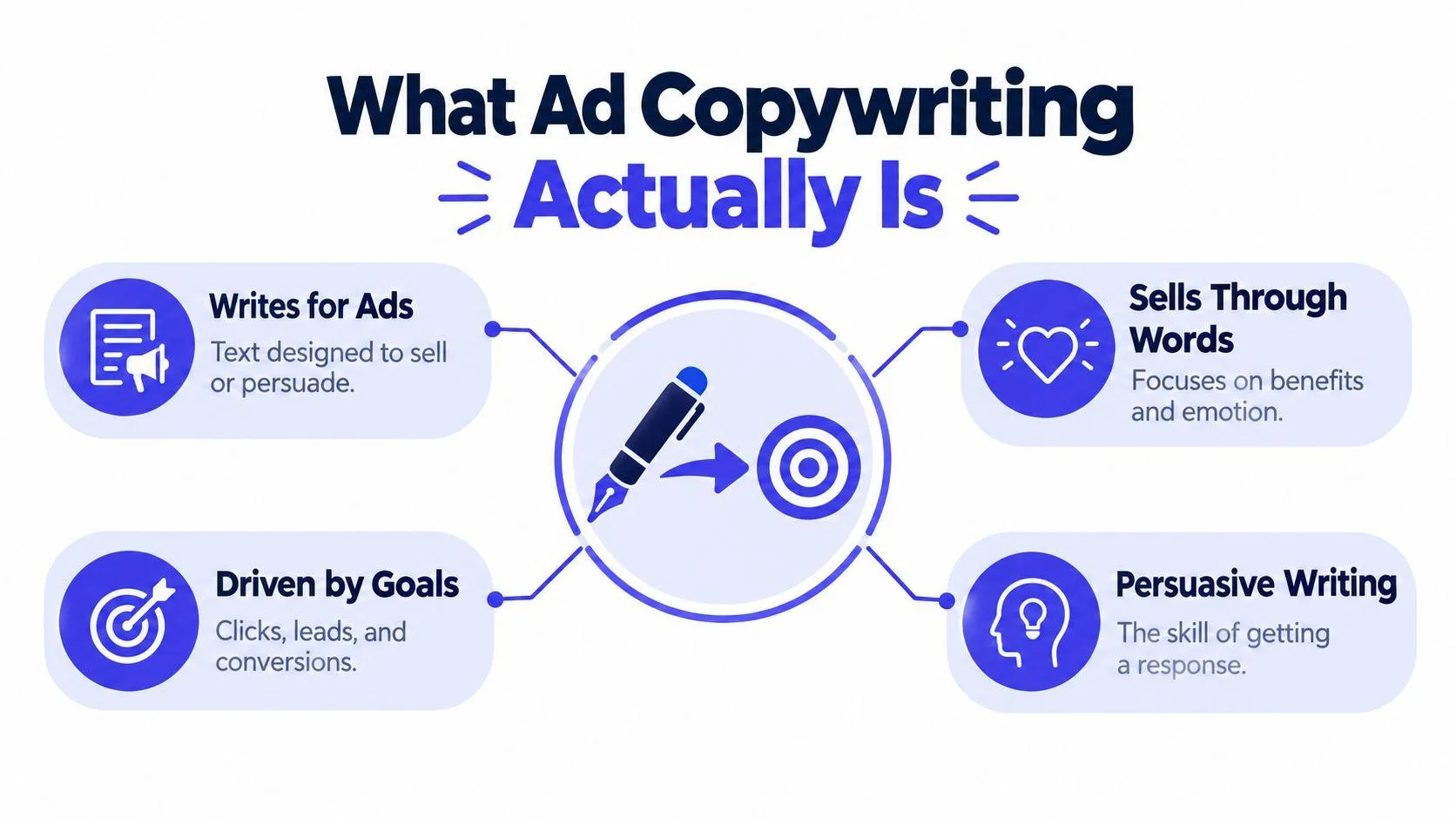
The four questions behind a short ad
A good ad answers four questions quickly:
- Is this for me? The wording should match the audience and the situation that brought them to the placement.
- What do I get? The reader needs a clear benefit, not a cloud of brand adjectives.
- Why should I believe you? Proof can take the form of a testimonial, credential, demonstration, comparison, or specific product detail.
- What happens if I act? The call-to-action should name the next step in plain language.
Suppose a language school sells online Spanish lessons. “Improve your communication with our new learning ecosystem” gives the reader little to hold on to. “Practice Spanish with short daily lessons” gives them a clearer idea of the offer and the experience.
Every ad brief is a small conversion system with four parts: an audience, an offer, a constraint, and an outcome. The audience determines the language. The offer determines the promise. The placement limits the format. The outcome determines what you measure.
Practical rule: Judge a draft by relevance to intent, clarity of promise, and strength of the call-to-action before judging how clever it sounds.
Ad copywriting also has a long history. The first American advertising agency is generally recognized as Volney Palmer’s agency, opened in Philadelphia in 1841. Agencies first sold newspaper space rather than creating advertisements, and they began offering copywriting as a service in the 1890s, alongside the rise of mass-circulation newspapers and magazines, as described in this history of ad copy and technical writing. The discipline grew because businesses needed words that could do more than fill space. They needed words that could produce a response.
How a Persuasive Ad Is Built
Most persuasive ads can be reduced to four connected parts: hook, claim, proof, and call-to-action. The structure works because it follows the reader’s decision path. First, you earn attention. Then you state the value. Next, you reduce doubt. Finally, you make the next move obvious.
Use one fictional offer throughout: an online course called Learn Guitar in 30 Days.
Start with the hook
The hook earns the first moment of attention. On a search page, it may mirror the reader’s query. In a social feed, it must interrupt passive scrolling. In a video, it has to work before the viewer loses interest.
“Learn Guitar in 30 Days, No Taps Needed” is a direct hook for someone who wants to play but feels blocked by complicated lessons. It names the desired result and removes a possible objection.
A hook doesn’t need to be loud. It needs to be relevant. “Your First Guitar Song Starts Here” could work for a beginner who wants an encouraging entry point rather than an aggressive promise.
Make one claim
The claim tells the reader what the offer can do for them. “Master a song in one session” is stronger than “Become a better guitarist” because it names an outcome the reader can picture.
Keep the claim narrow enough to understand in one breath. If the same line promises speed, low cost, expert teaching, unlimited access, confidence, and a complete musical transformation, the reader has to sort through too many propositions.
Add proof
Proof answers the silent objection, “Why should I trust this?” A testimonial, instructor credential, lesson preview, product demonstration, or clearly described method can support the claim.
The proof needs to fit the promise. A testimonial about enjoyable lessons may support an ease-of-use claim. It won’t automatically prove that a student can master a song in one session. Strong copy pairs the evidence with the exact doubt the reader is likely to have.
Finish with the CTA
The call-to-action tells the reader what to do next. “Start Your Free Lesson” is clearer than “Learn More” because it describes both the action and the immediate experience.
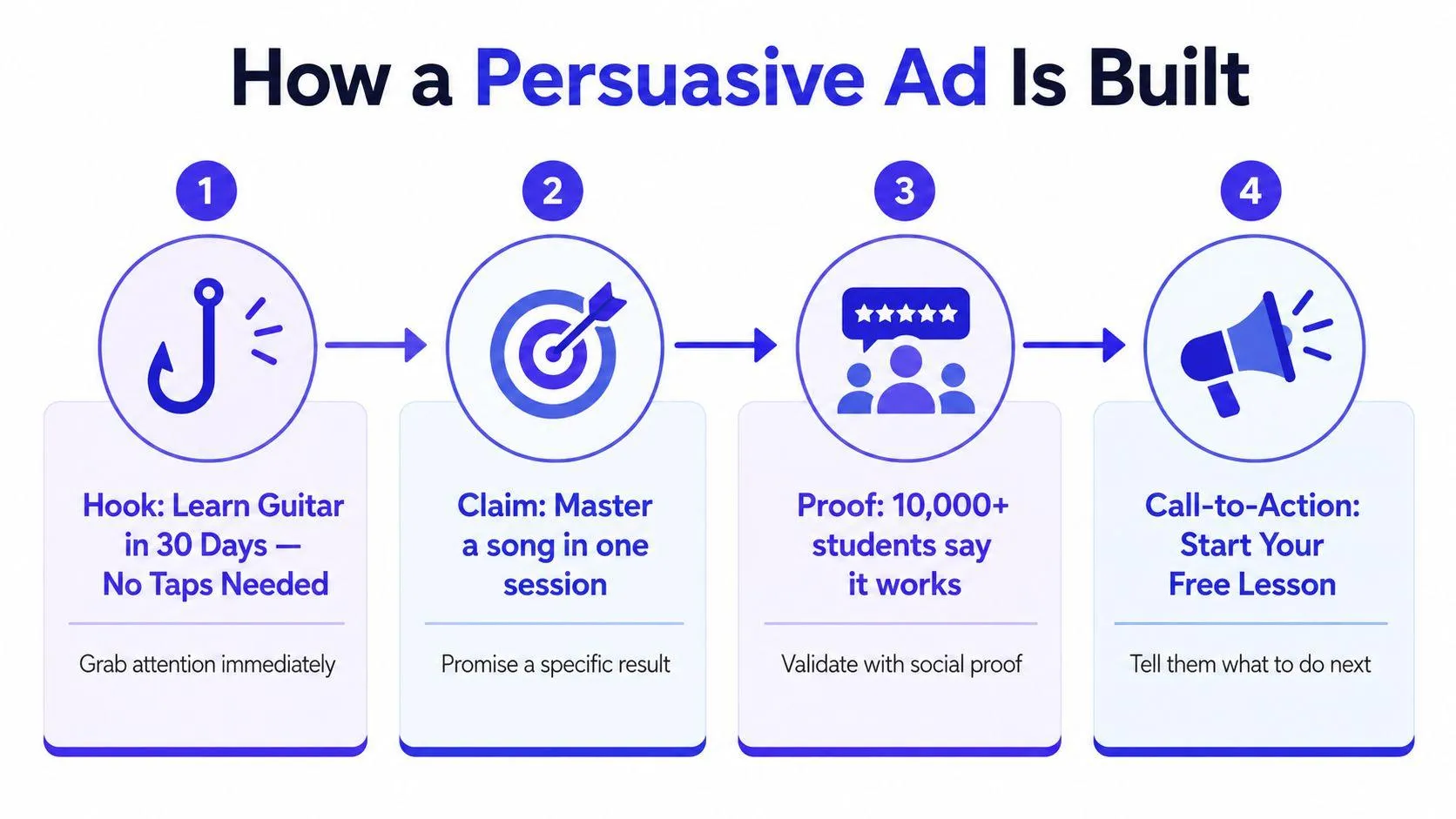
The skeleton stays stable across channels, but the container changes. A search ad may need compact keyword alignment. A social ad may let the caption develop a short story. A video ad can use voice and movement as part of the proof.
Before launch, pressure-test the draft:
- Hook: Would the idea survive muted autoplay or a fast scroll?
- Claim: Can someone understand it in one breath?
- Proof: Would a doubtful reader find it credible?
- CTA: Does it fit a quick thumb tap and name the next step?
Orwell’s Six Rules Applied to Ad Copy
George Orwell’s six writing rules provide a practical editing system for ads. Paid placements give readers little time, so every word should help them understand the offer or decide what to do. The Orwell Foundation’s reproduction of the rules recommends using short words, cutting unnecessary words, choosing the active voice, avoiding jargon and tired metaphors, and breaking a rule rather than writing something barbarous.
For ad copy, these are not academic preferences. They are checks on meaning, effort, and credibility.
Use short words when they clarify the offer
“Utilize our full solution” sounds formal but hides a simple instruction. “Use our tool” is easier to process.
Short words are not automatically better. They matter when they remove translation work. A reader should not have to turn corporate language into an ordinary idea before deciding whether the offer helps.
Put the actor near the action
“Leads are generated by us” makes the sentence stiff and delays responsibility. “We generate leads for you” names the actor immediately.
Active voice also exposes weak promises. Ask who performs the action, then put that person, team, or product close to the verb. This test is useful for service ads because it reveals whether the advertiser is promising an action it can actually take.
Replace jargon with a usable idea
“Work faster on my budget” gives the reader a concrete concern. “Align your approach” does not explain what changes or why it matters.
Specialized terms can belong in an ad when the audience uses them and they carry precise meaning. A software engineer may understand a technical feature name immediately. A general buyer may need the result in ordinary language. Choose the words that reduce uncertainty for the intended reader.
Cut padding and name what the buyer gets
“A wide range of options” leaves the offer blurry. “Templates for emails, landing pages, and ads” gives the reader something specific to assess.
This edit improves more than readability. Concrete nouns help a writer check whether the claim is accurate, help a designer choose supporting visuals, and give the reader a detail to remember. If a phrase cannot tell the buyer what is included, it may be taking space without adding meaning.
Trade praise for evidence
“A better way to work” describes the advertiser’s opinion. “Build a campaign brief from guided questions” describes an action the customer can understand.
Clichés make separate offers sound interchangeable. Specific details create a test for the promise: Can the reader see the task, result, or experience? If not, replace the praise with a feature, process, or proof point that supports the claim.
Break a rule for a clear reason
Orwell’s final rule allows a deliberate exception. A poetic headline may suit a fragrance, film, book, or emotional campaign. It can create a mood that plain instructions cannot. The exception should strengthen the idea, not hide an unclear benefit.
Read the ad in its actual channel before approving the style. A short headline must carry meaning with little context. A search description can explain a little more. A social caption may use a conversational rhythm, while a video line must sound natural when spoken. The same plain-writing test applies, but the available space and supporting format change.
Use this quick edit:
- Short words: Can a reader grasp the offer without translating it?
- Active voice: Who does the promised work?
- Plain language: Would the intended buyer use these terms?
- No padding: Can any vague phrase become a concrete detail?
- Evidence: What makes the promise believable?
- Intentional style: Does any unusual wording serve the idea?
Plain writing is not empty writing. It gives the reader less work, leaves less room for misreading, and makes the conversion path easier to measure.
Ad Copy Formats Across Channels
The same guitar course needs different copy on different surfaces. A copywriter’s first job is to fit the container. Cleverness comes later, if the format leaves room for it.
Search ads
A searcher has already expressed intent. The headline should connect with that intent, while the description can clarify the offer and provide a reason to choose it.
Learn Guitar Online
Practice short lessons at home with a guided course for beginners. Start a free lesson.
The wording is direct because the user is actively looking. A search ad doesn’t need to recreate the entire brand story.
Social feed ads
A Facebook or Instagram ad has to earn attention in a busy visual feed. The first line can sound more conversational, while the image or video carries part of the explanation.
Want to play your first song without leaving home?
Our beginner lessons break practice into simple steps. Try the opening lesson and see how it feels.
The copy can acknowledge a familiar frustration, then move toward the offer. A useful social media caption resource can help generate starting angles, but a writer still needs to check the claim, audience, and proof.
YouTube pre-roll
Video gives the advertiser sound, movement, and on-screen text. The spoken hook should work quickly, and the visual CTA should repeat the next action for viewers who aren’t listening.
“Want to play a song today? Start with one guided guitar lesson.” The screen can show the course name and a button-style prompt for the free lesson.
The copywriter should write for the ear, not the page. Spoken language needs natural rhythm and short clauses.
Programmatic display
A banner has little room for a full argument. One focused line may do more work than a crowded paragraph.
Play Your First Song
Beginner guitar lessons
Start Free
The visual design supplies context, so the text can concentrate on the outcome and action.
Retail and marketplace listings
A retail listing often relies on a product title and bullet features. The bullets replace a long sales pitch with scannable reasons to buy.
- Beginner friendly: Guided lessons for people starting from scratch.
- Short practice format: Clear sessions that fit around a busy day.
- Instant access: Begin from a connected device after purchase.
The offer hasn’t changed. The reader’s context has. Search emphasizes intent, social emphasizes interruption, video emphasizes spoken recall, display emphasizes compression, and retail emphasizes quick comparison.
Why Specificity Beats Multiple Claims
Consider two versions of an ad for the same project-management tool.
Flat version:
“Work faster with a flexible, affordable, trusted, cutting-edge platform built for modern teams.”
It tries to be fast, cheap, reliable, flexible, and current. None of those claims gives the reader a clear picture of what happens after the click.
Specific version:
“Turn meeting notes into assigned tasks with one shared workspace. See who owns the next step.”
The second ad chooses a concrete job. It gives the reader a named outcome and a way to picture the product in use.
This approach follows the hook, claim, proof, and CTA model described in this guide to writing advertisements. The strongest version isolates one promise, supports it with evidence, and ends with one action instead of asking the reader to process a stack of benefits.
Why concrete details help
Numbers, timeframes, named outcomes, and visible mechanisms can function as evidence because they make a promise easier to test mentally. “Improve your workflow” is abstract. “See who owns the next step” describes a situation the buyer already recognizes.
The principle isn’t that every ad needs a number. It’s that every ad needs something specific enough to remember. A named result can be just as useful as a quantity when the result solves a clear problem.
| Element | Flat Multi-Claim Ad | Specific Single-Claim Ad |
|---|---|---|
| Main message | Fast, affordable, trusted, flexible, innovative | Turn meeting notes into assigned tasks |
| Reader effort | Sort through competing benefits | Understand one practical use |
| Proof direction | Difficult to match evidence to every claim | Easy to demonstrate in the product |
| Memory | General and interchangeable | Tied to a recognizable task |
| CTA | Likely broad, such as Learn More | Try the shared workspace |
Publicly summarized industry research reports that creative quality accounts for 49% of ad-driven sales outcomes, as noted in this overview of great ad copy. That figure doesn’t mean a line of copy operates alone. Targeting, offer, placement, landing page, and budget still matter. It does show why creative deserves disciplined attention even when those other conditions stay unchanged.
One ad, one claim, one proof point. A focused message has a better chance of surviving the scroll than a crowded one.
Specificity also improves testing. If an ad contains one central promise, you can change the hook, proof, or CTA and learn which element influenced the response. If every line changes at once, the result tells you less.
Beginner Templates You Can Fill In Today
Templates help when the blank page is the problem. They don’t replace research, but they give you a structure to adapt to the audience, offer, and placement.
Search ad template
Use this pattern:
Headline: [Keyword or need] for [audience]
Description: [Specific benefit]. [Proof or useful detail]. [CTA].
Worked example:
Headline: Online Guitar Lessons for Beginners
Description: Learn your first song with guided practice. Start a free lesson today.
The keyword or need should match what the searcher wants. The benefit should describe the outcome. The proof or useful detail should reduce uncertainty. The CTA should tell the reader what happens next.
Search platforms set their own field and character limits, and those limits can change. Draft the complete thought first, then edit it to the current placement requirements rather than forcing every campaign into an old count.
Social ad template
Use a conversational sequence:
Hook: [Question or surprising observation]
Story beat: [Problem the audience recognizes]
Offer: [Product or service that addresses it]
Soft CTA: [Low-friction next step]
Worked example:
Hook: Still stopping after the first guitar chord?
Story beat: Most beginners don't need more theory. They need a short practice path they can follow.
Offer: Learn Guitar in 30 Days gives you guided lessons for home practice.
Soft CTA: Listen to the first lesson and see if it fits.
The story beat earns attention by showing understanding. The offer then feels connected to the problem rather than dropped into the feed without context. For more examples of promotional phrasing, see this marketing copy examples guide.
Display template
Keep the banner compact:
Headline: [Desired result]
Sub-line: [Specific mechanism or audience]
Button: [Action]
Worked example:
Headline: Play Your First Song
Sub-line: Guided guitar lessons for beginners
Button: Start Free
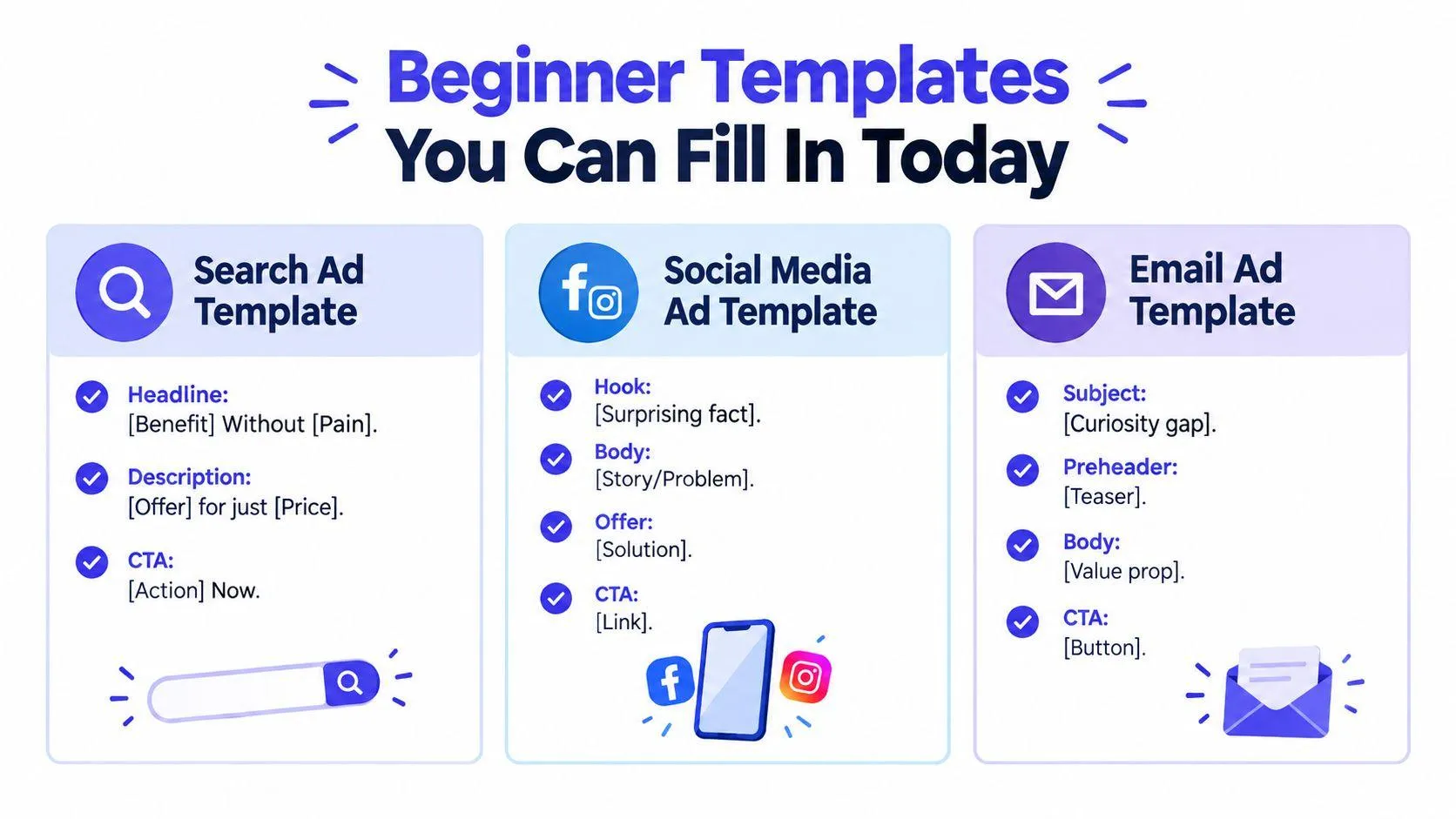
Use the template as a first draft, not a finished ad. Check whether the promise is true, whether the proof supports it, and whether the landing page continues the same message. Then create a second version that changes one meaningful element, such as the hook or CTA.
A copywriter improves by adapting patterns to real briefs. Repeated practice turns a structure into judgment, and testing turns judgment into evidence.
Measuring and Iterating Your Ads
Ad copywriting isn’t a one-shot writing task. It’s a loop: form a hypothesis, publish a controlled variation, read the response, and use the result to make the next decision.
Start with the business goal. If the campaign needs visibility, you may examine impression share or reach-related delivery signals. If it needs traffic, click-through rate and cost per click become more useful. If it needs leads or sales, conversion rate and cost per acquisition carry more weight. Upper-funnel placements may also require assisted or view-through conversion analysis because the ad can influence a later action without receiving the final click.
The metric should match the stage. A high click-through rate doesn’t prove that the offer converts. A low click-through rate may indicate a weak hook, poor intent alignment, or an audience mismatch. A strong conversion rate with expensive acquisition may point to an offer, bidding, or landing-page problem rather than a copy problem.
Set the test before you write
Write a short hypothesis before launch:
If we lead with the time-saving outcome for busy beginners, the audience will respond better than when we lead with the product’s feature list.
Then define the audience, offer, format, primary metric, and test window. Change one variable at a time where possible. If you replace the headline, image, CTA, and landing page together, you won’t know which change affected the result.
Avoid reacting to every early fluctuation. Let the test run long enough to provide useful evidence, then record what happened and what you’ll do next. The aim isn’t to declare a permanent winner from one result. The aim is to build a reliable body of learning.
The next-assignment checklist
- Define the goal: Choose the action the campaign must produce.
- Pick the primary metric: Select the measure closest to that action.
- Draft two variants: Keep the audience and offer stable while changing one angle.
- Set the test window: Decide when you’ll review the result.
- Log the learning: Record the claim, proof, CTA, and outcome.
- Promote the winner: Use the stronger version as the next control.
The best ad copywriters don’t depend on one clever headline. They compound small, clearly measured decisions across campaigns.
Prompt Like A Pro helps marketers create structured prompts for copy tasks by asking clarifying questions about the audience, format, length, and constraints before producing a prompt for an AI assistant. Visit Prompt Like A Pro to turn your next ad brief into a clearer starting point, then apply the hook, claim, proof, and CTA discipline yourself.
Build yours with the wizard
Prompt Like A Pro asks a few questions about your task, then writes a complete prompt for ChatGPT, Claude or Gemini. Free, no signup.
Make a prompt →