
10 Ad Copy Generator Tools Compared: Strengths and Pricing
It’s Monday morning, and Friday’s campaign launch is already breathing down your neck. You need headlines, primary text, and call-to-action lines that do more than fill space. You need an ad copy generator that gives you usable variants after the first draft, not just a pile of sameness. That’s the true test, because the second and third passes decide whether the copy can survive brand review, channel limits, and a real media budget.
Table of contents
1. Rytr
Rytr is the kind of tool you open when the brief is short and the clock is shorter. Its value is simple: it helps you move from blank page to working ad variants fast, with a low-friction interface and enough tone options to cover most lightweight campaigns. The official site is straightforward, and that matters when a solo marketer just wants to start drafting at Rytr, not study a product map.
Where it helps after the first draft
Rytr works best when you need several versions of the same promise and you’re willing to edit by hand. It’s a practical fit for solo creators and small teams that want volume without a heavy setup. It is less compelling if you need scoring, strict brand control, or a workflow that tells you which variant deserves a paid test.
Practical rule: use Rytr for roughing out angles, not for final approval.
Sample ad output, in plain English, would sound like this, “Write ads faster with one simple prompt. Create new headlines, cleaner body text, and sharper calls to action in minutes.”
Its low-cost model makes sense for a small budget, because you’re paying for speed and convenience rather than deep governance. The trade-off is visible in the output. You’ll likely get decent options, but you’ll still have to tighten claims, improve specificity, and match the brand voice yourself.
Rytr fits buyers who need affordable draft volume and don’t mind editing. It does not fit buyers who want predictive scoring, regulated-category guardrails, or a tool that makes the final call for them.
2. Writesonic
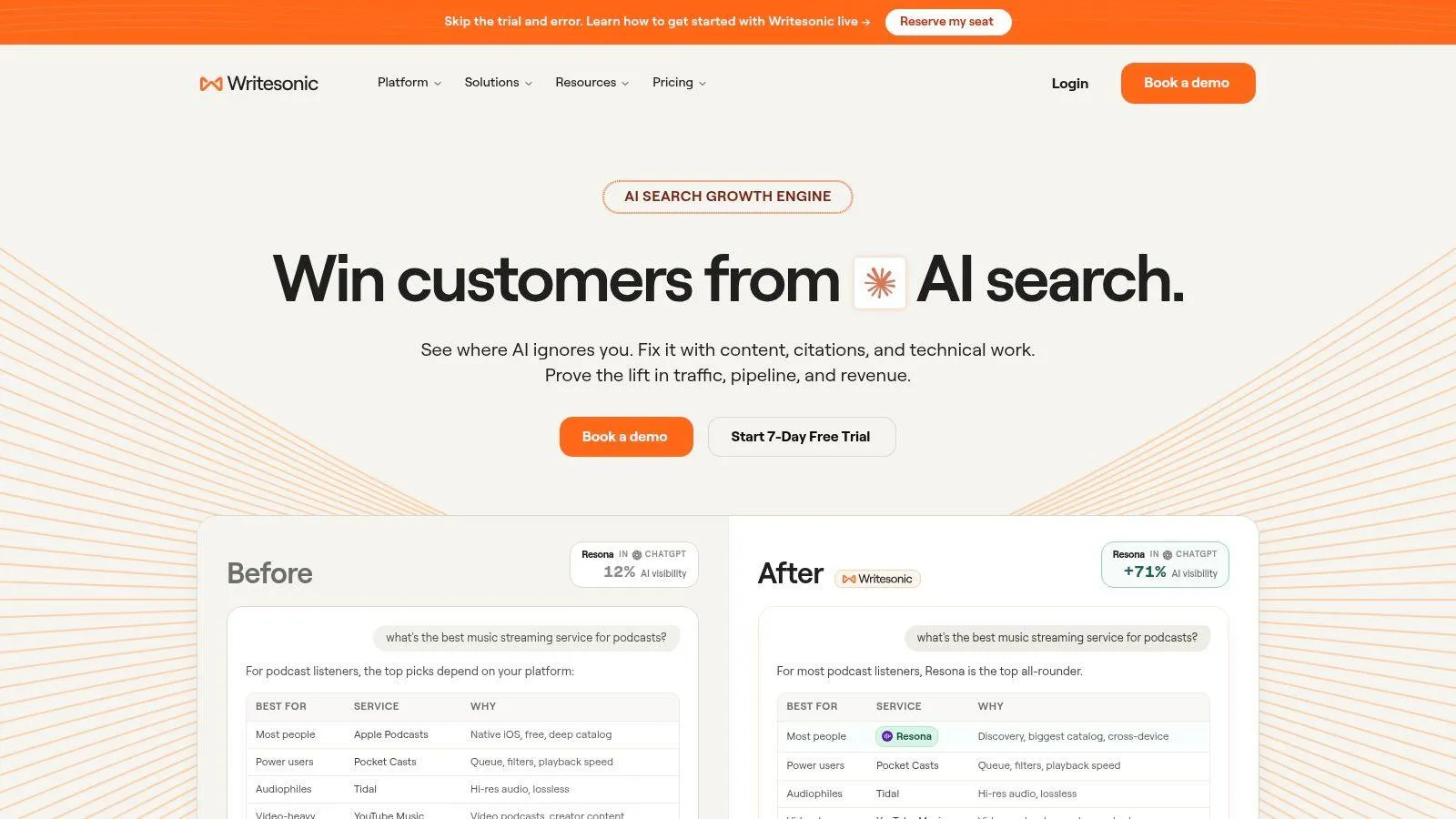
Writesonic sits in the middle ground between a writing helper and a broader marketing suite. It has ad templates for Meta and Google, so you can move from one campaign to another without rebuilding your process each time. If you also manage landing pages and content, that broader footprint can save time, especially when one team handles both ads and on-site copy. Start with the product page at Writesonic.
What happens when the first draft lands
The useful part is not just that it writes ads. It is that you can keep pushing the same brief into new angles quickly, which makes it easier to compare benefit-led, urgency-led, and problem-led copy. That said, the pricing and plan names change often enough that you should verify what’s included before you commit. The product can feel broader than you need if all you want is simple ad copy.
Sample output might read, “Turn more clicks into customers with clearer ad copy. Use targeted headlines, simple benefits, and direct calls to action for every channel.”
The best buyer is a team that wants ad copy plus content operations in one place. The wrong buyer is someone who needs a very tight compliance layer or a fixed pricing model that won’t shift under them. If your team is small and your use case is narrow, you may end up paying for surface area you never touch.
Writesonic fits teams that run ads and content together. It does not fit buyers who want the smallest possible tool with the fewest moving parts.
3. Copy.ai
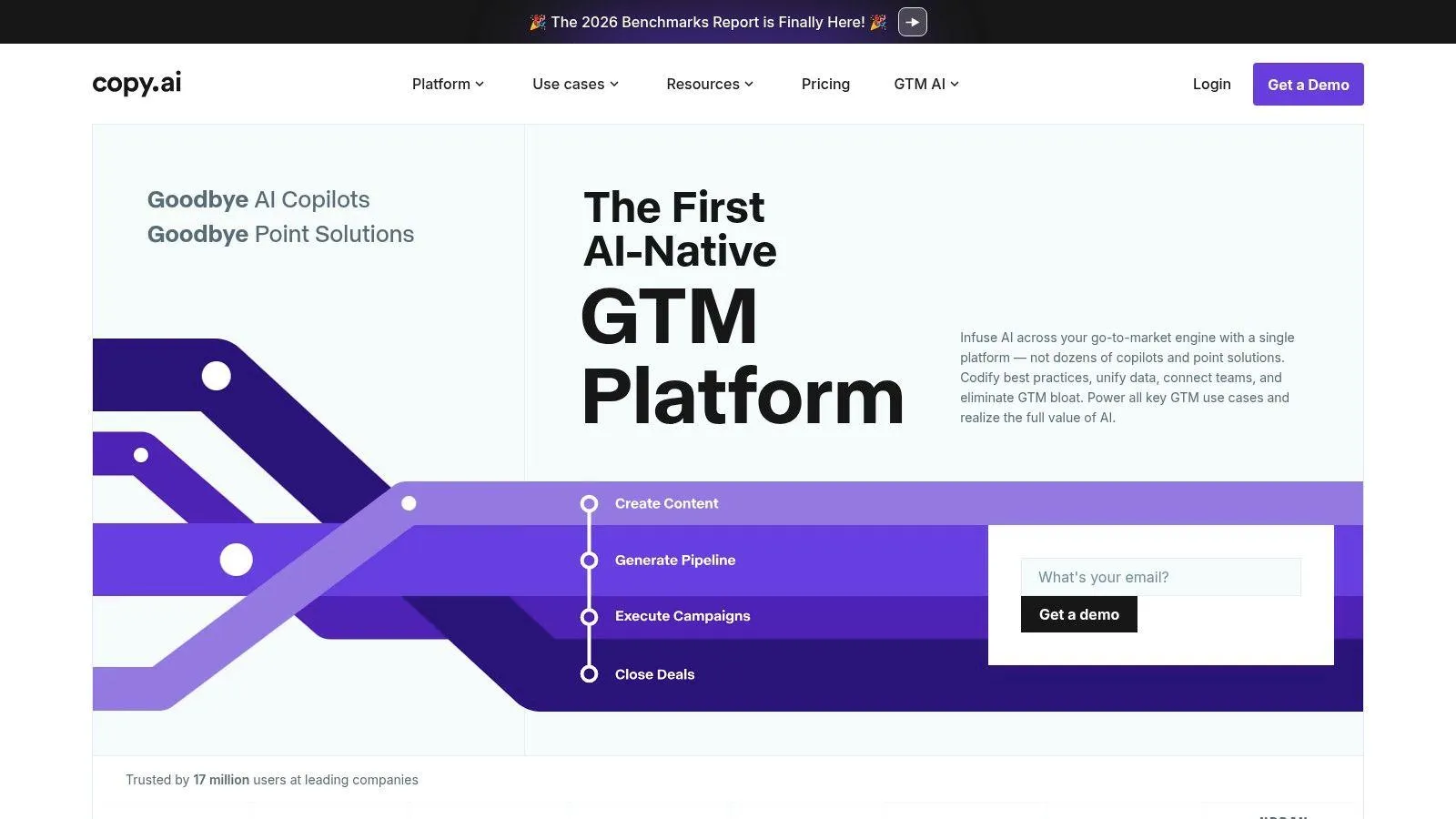
Copy.ai is built for teams that want ad generation to become a repeatable process, not a one-off task. The workflows and integrations matter more than the first draft itself, because they let you move from idea to production without rebuilding the same prompt over and over. For teams that live inside GTM operations, that can be the win at Copy.ai.
The usable output is the repeatable one
A good ad copy generator should help you create one strong batch, then another one that is still on brief. Copy.ai is useful there because it gives teams a way to package generation into workflows, especially when they’re producing variants for Google or LinkedIn. The downside is simple. The more automation you want, the more likely you are to end up on a higher tier.
Sample ad output could be, “Launch more ads without starting from scratch. Turn a product page into clean headlines, concise descriptions, and campaign-ready variations.”
Buyer fit: teams that want a process and have enough volume to use workflows.
Not a fit: buyers who only need a quick headline generator once in a while.
Its strength is operational consistency. Its weakness is that the best automation lives behind more expensive tiers, so a small team can feel boxed in if it only needs the advanced parts occasionally. If you want ad copy plus a system you can repeat across campaigns, it earns a look. If you only want cheap drafts, it’s probably too much.
4. Jasper
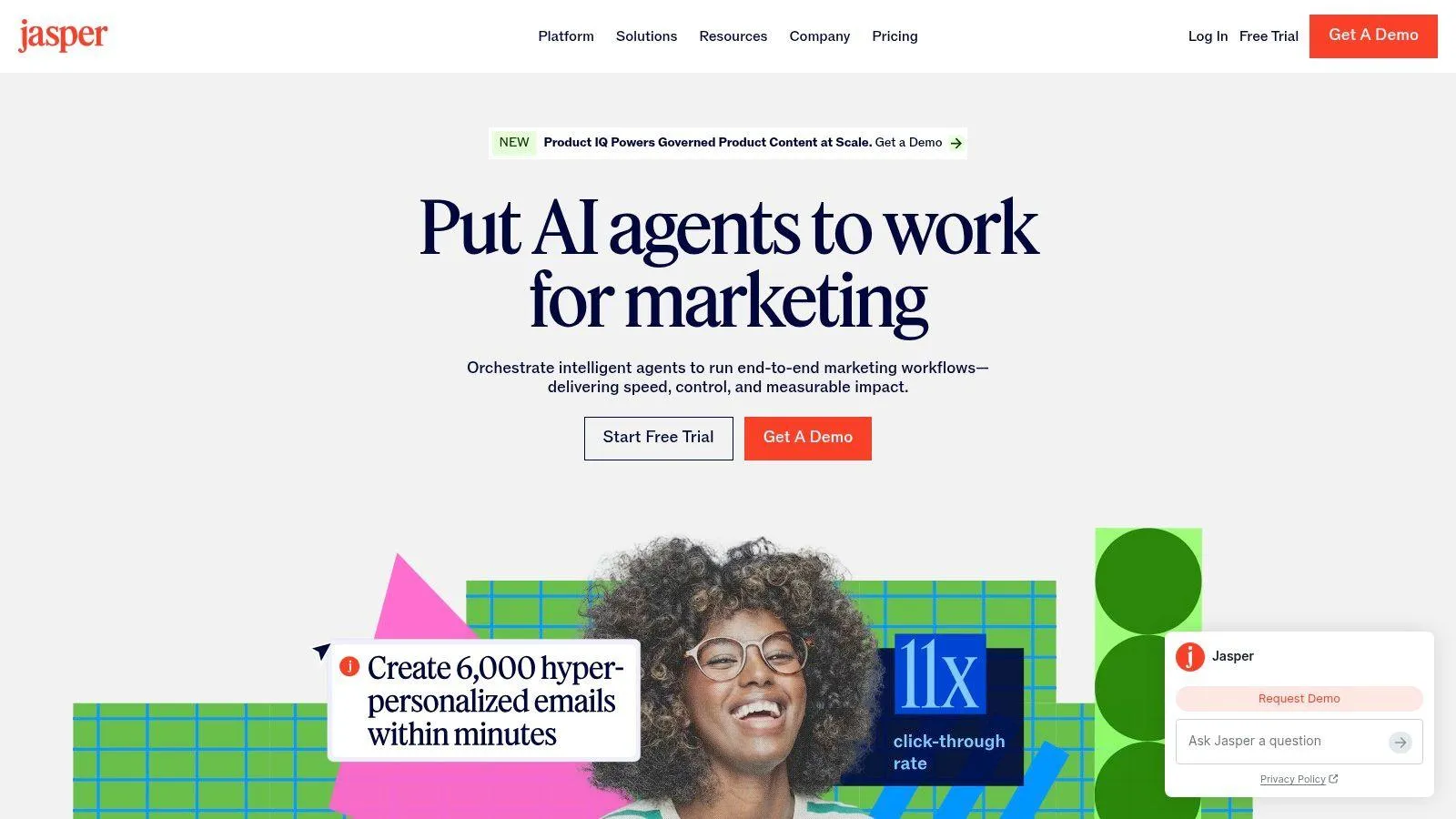
Jasper makes sense when brand consistency is the hard part, not the first draft. It is designed for teams that want a shared tone, shared guardrails, and fewer handoffs between brand, creative, and media buying. That matters when more than one person touches the copy before it goes live, and it matters even more when the brand can’t afford drift. See the platform at Jasper.
Brand controls change the decision
Jasper’s practical value shows up after drafting. If the tool can codify voice and style, it can reduce review loops that usually slow down ad launches. That makes it stronger for regulated teams and multi-brand setups than for a freelancer who just wants a quick ad set. The cost is also higher than lightweight writers, so you should only pay for it if brand control is part of the job.
Sample output might be, “Stay on brand while you scale. Create ad copy that sounds like your team, keeps the same tone, and moves cleanly across channels.”
Jasper fits teams that care about consistency across many campaigns. It does not fit buyers who want the cheapest way to produce a few ads for a single offer. If you do not need brand governance, some of what you pay for will sit unused.
5. Anyword
Anyword is built around the idea that a draft is more useful when you know which version is likely to work before launch. That scoring approach changes how you choose copy, because it moves the decision from taste to ranking. For data-driven marketers, that is the point of using Anyword.
Scoring matters when you have too many options
If a tool gives you twenty variants and no way to narrow them down, the bottleneck just moves from writing to selection. Anyword helps by adding a scoring panel and demographic signals, which makes the short list easier to defend in a team review. The trade-off is price and complexity. It makes more sense when you already measure ad impact carefully than when you only need fast draft generation.
Sample output could be, “Pick the ad that scores higher before you spend. Compare variants by likely performance, then test the one that matches your audience.”
Practical rule: scoring is useful when it changes what you launch, not when it just decorates the interface.
Anyword fits teams that want to rank copy before they spend media budget. It does not fit teams that want the lowest monthly bill or a bare-bones writer. If you will never use the scoring data, you’re paying for a feature you won’t operationalize.
6. AdCreative.ai
AdCreative.ai is built for paid media, so it treats copy as part of the full creative set. That matters if you need images, videos, and ad text together, because the workload is usually bigger than a headline request. You can see the platform positioning at AdCreative.ai.
Copy and creative should live together
The advantage here is not just generation. It is that the tool can help you prioritize which creative concepts deserve launch, which is useful when the team is juggling many variants at once. The downside is the plan structure, which can feel more complex than pure copy tools. Credit-based downloads also make the buying decision feel less linear than a simple seat-based plan.
Sample ad output might read, “Launch ad creative that works harder from the first test. Generate copy, visuals, and variants designed for paid media in one flow.”
It fits marketers who want ad text and creative in one place, especially when launch speed matters. It does not fit people who only need words. If your workflow stops at copy review, the rest of the platform may be more machinery than you need.
For a practical framing of ad formats and copy types, this guide to ad copy examples is a useful companion.
7. neuroflash
neuroflash leans into audience intelligence and data protection. That combination makes it attractive for EU-centric teams, especially when ad copy needs to be tested against modeled audiences before launch. The company’s pricing page and product materials make the GDPR and hosting angle part of the pitch at neuroflash.
Better for teams that care about privacy posture
The after-the-draft question here is whether the copy is likely to resonate, not just whether it reads cleanly. That’s where the Digital Twins angle becomes useful, because it pushes teams to think about audience fit before launch. The pricing in EUR and the model-credit setup can take a minute to understand, though, so onboarding matters more than with simpler writers.
Sample output could be, “Test ad language before you spend. Generate copy, check audience fit, and tighten the version that feels most credible for your market.”
Practical rule: if data handling is part of the buying decision, bring that concern into the vendor review, not after the trial ends.
neuroflash fits teams with strict privacy rules or EU hosting requirements. It does not fit people who want the easiest possible pricing page or a frictionless entry point. The value is in the control layer, not in speed alone.
8. Phrasee
Phrasee is an enterprise language platform, not a lightweight ad writer. That distinction matters, because its strengths show up when scale, brand control, and optimization across channels are all in play. If you’re buying for a large brand, start from the enterprise positioning at Phrasee.
Enterprise tools win on control, not convenience
A tool like this earns its place when ad language has to travel through multiple systems and approval layers. That means it can fit email, push, social ads, and web copy in the same stack, which is useful for big teams that need consistency. It does not feel built for small teams, and the lack of public pricing says enough about who it is meant to serve.
Sample ad output might be, “Keep your brand language consistent across every channel. Optimize messaging, personalize at scale, and manage copy inside enterprise workflows.”
Buyer fit: large teams with strict voice rules and approval chains.
Not a fit: small teams that want to test copy this afternoon.
Phrasee fits brands that need procurement-friendly software and channel-specific optimization. It does not fit buyers who want transparent self-serve pricing or a quick signup. The platform is about managed language systems, not fast experimentation.
For the underlying concept of ad copywriting itself, this overview of what ad copywriting is gives useful context before you compare enterprise tools.
9. Hypotenuse AI
Hypotenuse AI makes the most sense when your product data is the source of truth. That’s common in e-commerce, where ad copy has to stay aligned with feeds, attributes, and taxonomy. A generic writer often falls apart there. Hypotenuse AI is built to keep the copy close to the catalog, and you can review the product at Hypotenuse AI.
Feed sync changes the value
After the first draft, the question is whether the tool can still stay accurate as the catalog changes. That is where a brand voice model and guideline checker matter, because they keep the ad text inside the rules of the channel and the product set. The trade-off is obvious. Pricing is largely custom, so smaller teams may not get the easy entry they want.
Sample ad output could be, “Turn product data into ad copy that stays accurate. Keep messaging aligned with your feed, your taxonomy, and your brand rules.”
Hypotenuse AI fits mid-market and enterprise e-commerce teams that need scale and consistency. It does not fit shoppers for cheap, public, low-commitment pricing. If you are managing large catalogs, that custom approach can be worth it. If you only have a few SKUs, it may be more platform than you need.
10. Prompt Like A Pro
A rough ad brief can waste a good model. Prompt Like A Pro is built to fix that. It does not write the ad for you. It helps you shape the prompt so the assistant you already use has enough context to produce better drafts. Start with the free tool at Prompt Like A Pro.
Questions first beats one-shot rewriting
It asks five to seven targeted questions, then turns the answers into a structured prompt you can paste into ChatGPT, Claude, Gemini, Midjourney, or another assistant. That matters because ad copy usually fails when the input is thin. Give the model audience, format, constraints, length, and campaign context, and the first draft is usually closer to something usable.
Sample output might read, “Build three ad variants for busy founders. Keep the tone direct, the offer clear, and the call to action short. Stay within channel limits and preserve the brand voice.”
Practical rule: if your prompts start with “write an ad for my product,” you are leaving too much to chance.
The pricing is simple. You can use it free, keep prompts local in your browser, and pay a one-time US$7 fee for unlimited saves. For a small team, that avoids another subscription. The trade-off is also clear. Saved prompts stay local, so there is no shared workspace or cloud sync.
Prompt Like A Pro fits marketers, founders, and writers who want stronger inputs before they generate ads. It does not fit teams that need a shared workspace or a tool that produces finished ads on its own. It is the right pick when your drafts fail because the brief is thin. It is the wrong pick when you need team collaboration or ready-made ad output.
Top 10 Ad Copy Generators, Comparison
| Tool | Core features | UX & Quality ★ | Target audience 👥 | Pricing / Value 💰 | Unique selling point ✨ |
|---|---|---|---|---|---|
| Rytr | 40+ use cases, simple UI, Chrome ext | ★★★ | Solo creators & small teams | 💰 Free tier; low-cost unlimited plan | ✨ Fast, budget-friendly ad variations |
| Writesonic | Ad templates, brand voice, SEO/GEO tools | ★★★★ | SMBs & content teams | 💰 Free/paid tiers; verify plan inclusions | ✨ Integrated SEO/GEO tracking for pages |
| Copy.ai | Ready templates + workflows; multi-model access | ★★★★ | GTM teams & agencies | 💰 Free tier; paid workflows on higher plans | ✨ Repeatable campaign workflows & automations |
| Jasper | Brand Voice, campaign workflows, team controls | ★★★★★ | Enterprises & regulated brands | 💰 Higher-priced; seats + credits | ✨ Strong brand governance at scale |
| Anyword | Predictive Performance Scores; demographic insights | ★★★★ | Data-driven marketers | 💰 Mid–upper pricing | ✨ Predictive scoring to prioritize variants |
| AdCreative.ai | Generates images/videos + ad text; scoring | ★★★★ | Paid-media teams needing visuals | 💰 Credit-based plans; enterprise tiers | ✨ Creative scoring + end-to-end visuals + copy |
| neuroflash | Digital Twins pre-testing; SEO & research modes | ★★★★ | EU teams & privacy-conscious brands | 💰 EUR pricing; tiered credits | ✨ GDPR-forward hosting; audience pre-tests |
| Phrasee | Real-time language optimization & analytics | ★★★★★ | Large brands & enterprise marketing stacks | 💰 Enterprise-only; sales contact | ✨ Channel-specific optimization with analytics |
| Hypotenuse AI | Bulk product content; feed sync; brand checks | ★★★★ | E‑commerce & catalog teams | 💰 Custom pricing; demo required | ✨ Product-feed sync + compliance (SOC2) |
| 🏆 Prompt Like A Pro | Questions-first generator; structured, model-aware prompts; large prompt library | ★★★★ | Prompt users across ChatGPT/Claude/Gemini/Midjourney; creatives & devs | 💰 Free; optional one-time US$7 for unlimited local saves | ✨ No signup, privacy-first (local saves); model-tailored formatting |
Match the Tool to the Job, Then Test Before You Commit
Choose by the job in front of you. Use budget writers when you need volume, suites when the same team also runs landing pages, and scoring tools when you must rank variants before spending money. That is the cleanest way to avoid paying for a platform you won’t fully use.
Test three to five variants from each shortlisted product on a small budget, then keep the copy that performs best on your own numbers. Don’t trust a polished preview alone. A good-looking sample can still lose once it hits your audience, your offer, and your channel mix.
Check current plan prices on each vendor site before you buy, because several listed plans and credit rules change often. Verify what you get, how limits are counted, and whether any advanced features sit behind a higher tier.
Ready-made prompts for this
Build yours with the wizard
Prompt Like A Pro asks a few questions about your task, then writes a complete prompt for ChatGPT, Claude or Gemini. Free, no signup.
Make a prompt →Read next
10 Ad Copy Examples and Why They Work
Ten ad copy examples across email, search, social, video and landing pages, with the reasoning behind each so you can reuse the pattern.
Read the guide →