
How to Write Ad Copy for Facebook That Converts
The most popular advice about ad copy for Facebook is to pick a formula, sharpen the hook, and add urgency. That’s a useful drafting exercise, not a strategy. A polished ad can still sell the wrong benefit, attract the wrong click, or promise something the landing page doesn’t deliver.
Treat copy as a hypothesis you can test. State a real problem, explain the offer in plain English, and ask for a clear action. Then find out whether that message brings the right people to the page, not just whether it gets attention.
Table of Contents
Why Most Facebook Ad Copy Advice Stops Working in 2026
PAS, AIDA, and swipe-file headlines can help you organize a draft. They can’t tell you which concern matters to your buyer. A pain-first opening is a poor choice when the reader already understands the problem but doubts your solution.
The bigger mistake is confusing a familiar structure with a useful message. Replace the product name in your ad with a competitor’s name. If the copy still works unchanged, you probably haven’t said enough about the offer.
Relevance beats a louder opening
Facebook advertising developed inside a social environment. Its early Flyers promotions served students, its formal advertising platform introduced brand Pages and Social Ads in November 2007, and News Feed ads and Custom Audiences followed in 2012, as documented in Wired’s history of Facebook’s defining moments.
The practical lesson isn’t nostalgia. Write for someone encountering a message among other people’s posts, not someone who has asked to read a sales presentation. Establish a recognizable situation before asking the reader to care about your brand.
Compare these hypothetical openings:
- Empty excitement: “Discover the future of smarter work.”
- Recognizable problem: “Your AI draft sounds nothing like your business.”
- Specific offer: “Turn your task notes into a structured AI prompt.”
The latter openings give you distinct ideas to test. The first mainly gives you adjectives to edit.
Don’t confuse polish with substance
AI-assisted drafting makes it easy to produce many versions of the same weak idea. Changing “transform” to “improve” doesn’t create a new angle. Changing the reason someone should act does.
A useful opening should help the reader recognize their problem. The rest should explain what they’ll get and what to do next. That sounds basic because it is. Basic decisions deserve more attention than decorative hooks.
Practical rule: If you can’t name the buyer’s concern without using your product slogan, stop drafting and clarify the offer.
Character counts, disclosure wording, and testing methods matter after that decision. None can rescue an ad that leaves the reader unsure what’s being offered.
Facebook Ad Copy Formats and Character Limits That Actually Matter
Write for what the reader can see, not for the space the editor lets you fill. Text that fits in an input field may still appear cut off, hidden, or awkward beside the creative.
The distinction is working range versus hard limit. These drafting targets help you preserve meaning across placements. They aren’t promises that every device and layout will display identical text.
Facebook Ad Copy Format Reference
The following working ranges come from Benly’s Meta ad creative specifications guide: primary text can truncate near 125 visible characters, headlines commonly target 27–40 characters, and descriptions are often kept near 25–30 characters; the former 20% image-text rule is no longer enforced, although heavier image text can still reduce delivery and increase costs.
| Format Element | Working Range | Truncation Risk |
|---|---|---|
| Primary text | Opening within the visible threshold noted above | The explanation may disappear behind expansion |
| Headline | Use the short headline band noted above | Important closing words may be cut |
| Description | Use the compact description band noted above | Treat it as supplementary, not essential |
| Text within the creative | Keep it selective and readable | Crowding can weaken legibility |
| CTA | Match the intended next action | A vague instruction can leave expectations unclear |
Don’t hide the product name, offer condition, or essential qualification at the end of a paragraph. Put enough meaning up front that a reader can understand the ad without expanding it.
Longer copy can still earn its place. Use the extra space to explain a mechanism or answer a real objection, not to repeat the opening in different words.
Preview the message, not just the layout
Inspect Feed, Stories, and Reels separately. Ask whether the visible text still makes sense when the surrounding elements change.
- Feed: Check whether the opening stands alone and the headline adds useful information.
- Stories: Make sure the message doesn’t depend on a long paragraph being read.
- Reels: Check that the text supports the video rather than competing with it.
Avoid copying the entire primary text onto the image. Give each element a job: the creative shows, the primary text explains, and the headline reinforces the offer. If removing the description breaks the message, move that essential information somewhere more dependable.
Write the Five-Part Copy Unit in Plain English
A useful draft contains a hook, specific problem, mechanism, proof or risk reducer, and CTA. That’s an assembly method, not a demand to write a separate sentence for each part.
Consider this deliberately bloated example for a hypothetical prompt-building tool:
Unlock your limitless creative potential with a revolutionary prompt ecosystem that empowers seamless AI collaboration. Experience next-generation productivity and transform your workflow today.
Nothing explains what the tool does. The reader gets no useful basis for deciding whether to click.
Replace claims with a mechanism
A plain-English version might read:
Generic AI drafts? Give your assistant a clearer brief. Our tool turns your task details into a structured prompt you can review before use. Build your prompt.
The hook names a recognizable frustration. The mechanism explains the product, and the ability to review the result reduces uncertainty without inventing a testimonial or performance claim.
Here’s the reusable assembly pattern:
- Hook and problem: Name the situation the reader wants to change.
- Mechanism: Explain what the product does.
- Evidence or reassurance: Add a verified demonstration, relevant fact, or genuine risk reducer.
- CTA: Ask for the next step the landing page supports.
Use worked ad copy examples to examine those decisions, not to collect phrases to paste into unrelated offers.
Apply Orwell’s editing rules
George Orwell’s six rules, published in 1946 in “Politics and the English Language”, provide a practical editing standard:
- Drop worn-out imagery: Replace “unlock your potential” with the actual task or outcome.
- Prefer short words: Write “use,” not “utilize.”
- Cut needless words: Remove “designed to help you” when a direct verb works.
- Prefer active construction: Write “Review your prompt,” not “Your prompt can be reviewed.”
- Replace jargon: Explain the function instead of naming an impressive-sounding system.
- Break a rule before writing something absurd: Keep a familiar technical term when the plain-language substitute would confuse the buyer.
Don’t edit away necessary detail just to make the ad shorter. “Structured prompt” may be more useful than “better words” for an audience that understands prompting.
The standard is clear meaning, not the fewest possible syllables. Read the draft aloud, then underline every claim that needs evidence. If you can’t support it, remove it or narrow it.
When and How to Disclose AI Involvement in the Ad
Consider a hypothetical founder advertising a privacy-first writing tool. She uses an AI assistant to draft several angles, checks each product claim, and rewrites the copy in her customers’ language. Should the ad mention that process?
“Never disclose” is too blunt. So is attaching a large AI label to every routine editing task. The useful question is what the customer needs to understand about how the message was made.
What the evidence does and doesn’t establish
A 2025 field experiment on ChatGPT disclosure in social-media advertising found that disclosure increased engagement and purchase intention for both fully AI-generated and human–AI co-produced content. That finding challenges the assumption that disclosure must hurt persuasion; it doesn’t establish that every disclosure will improve every campaign.
Human review and a clear explanation of AI’s role are sensible starting points. But “human-reviewed” must describe work someone performed, not a reassuring label added automatically.
For the founder, meaningful review means checking the privacy promise, verifying the product mechanism, removing unsupported outcomes, and confirming that the landing page matches the ad. Approving a fluent draft without checking those details isn’t the same thing.
Choose placement by relevance
| Placement | Use it when |
|---|---|
| Ad copy | AI involvement materially affects how the reader should interpret the message |
| Landing page | Buyers need more detail about drafting, review, or generated content |
| Brand policy | You need a stable explanation of your general AI practices |
These are editorial choices, not substitutes for applicable legal or platform requirements. Don’t move a necessary disclosure to an obscure policy page just to keep the ad tidy.
Possible wording includes “AI-assisted, human-edited” or “Drafted with AI and checked by our team.” Use either only when it’s accurate, and explain the process more fully where that would help the customer.
Transparency is useful when it tells the buyer something concrete. A label without an explanation can leave the real question unanswered.
Keep audience language intact during review. Feed the assistant approved terminology and prohibited claims, rather than asking it to “sound authentic.” Never turn generated praise into a supposed customer quote.
A Controlled A/B Test Workflow for Ad Copy
Start with a written hypothesis: People interested in this offer may respond more strongly to privacy than convenience. That’s testable. This version sounds punchier is an editing opinion.
Use the workflow below to keep the experiment interpretable.
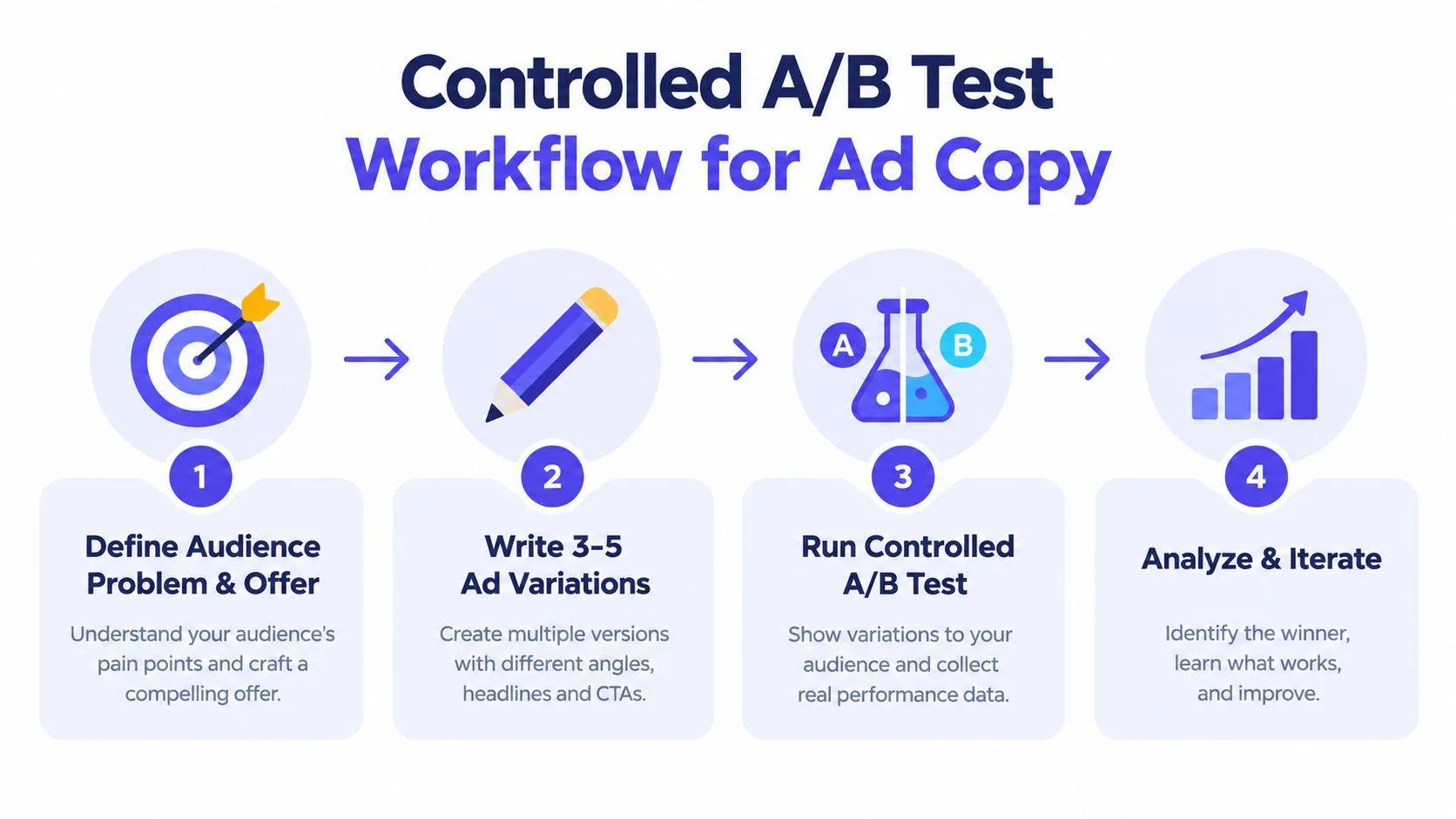
Define the decision before launch
Specify the audience problem, offer, and desired downstream action. Then create 3–5 distinct copy variations, keeping creative, audience, placement, bid strategy, and landing page constant; the controlled Facebook copy-testing guide recommends at least 400 impressions per variant as an initial floor and describes 50 conversion events per variant as a commonly used minimum for conversion-focused testing.
Those are planning thresholds, not guarantees of statistical certainty. A small difference can remain inconclusive even after a minimum is met. Don’t crown a winner because the dashboard shows a leader.
Use landing-page CTR as the primary directional copy signal. Check which metric your reporting view includes so you don’t mistake reactions or other interactions for visits to the destination.
Then examine CPC, qualified downstream actions, and cost per completed action. Purchase performance also depends on the offer, page, and audience quality. An ad that attracts more visits isn’t automatically the better commercial choice.
Test reasons to act, not synonyms
For a hypothetical privacy-first prompt tool, the test matrix could look like this:
| Angle | Message hypothesis |
|---|---|
| Privacy | Buyers care most about avoiding accounts and server-side prompt storage |
| Outcome | Buyers want a clearer brief for their AI assistant |
| Workflow | Buyers prefer guided questions to starting from a blank page |
Only use those claims if the advertised product supports them. Keep the visual and destination unchanged so you’re comparing the appeal of the messages.
If the budget can’t support adequate evidence across the variants, reduce the number of variants, rather than shortening the test until the result becomes guesswork.
Promote the strongest angle into a follow-up test of hooks or CTAs. Don’t change both at once, and don’t assume the winning message will remain strongest in a different audience or placement.
Diagnosing Creative Fatigue Before You Rewrite the Ad
A performance drop is a reason to investigate, not an instruction to write a louder hook. First establish where the decline begins: fewer people responding to the ad, fewer visitors completing the action, or higher costs despite similar response.
Use this diagnostic checklist before replacing the message.
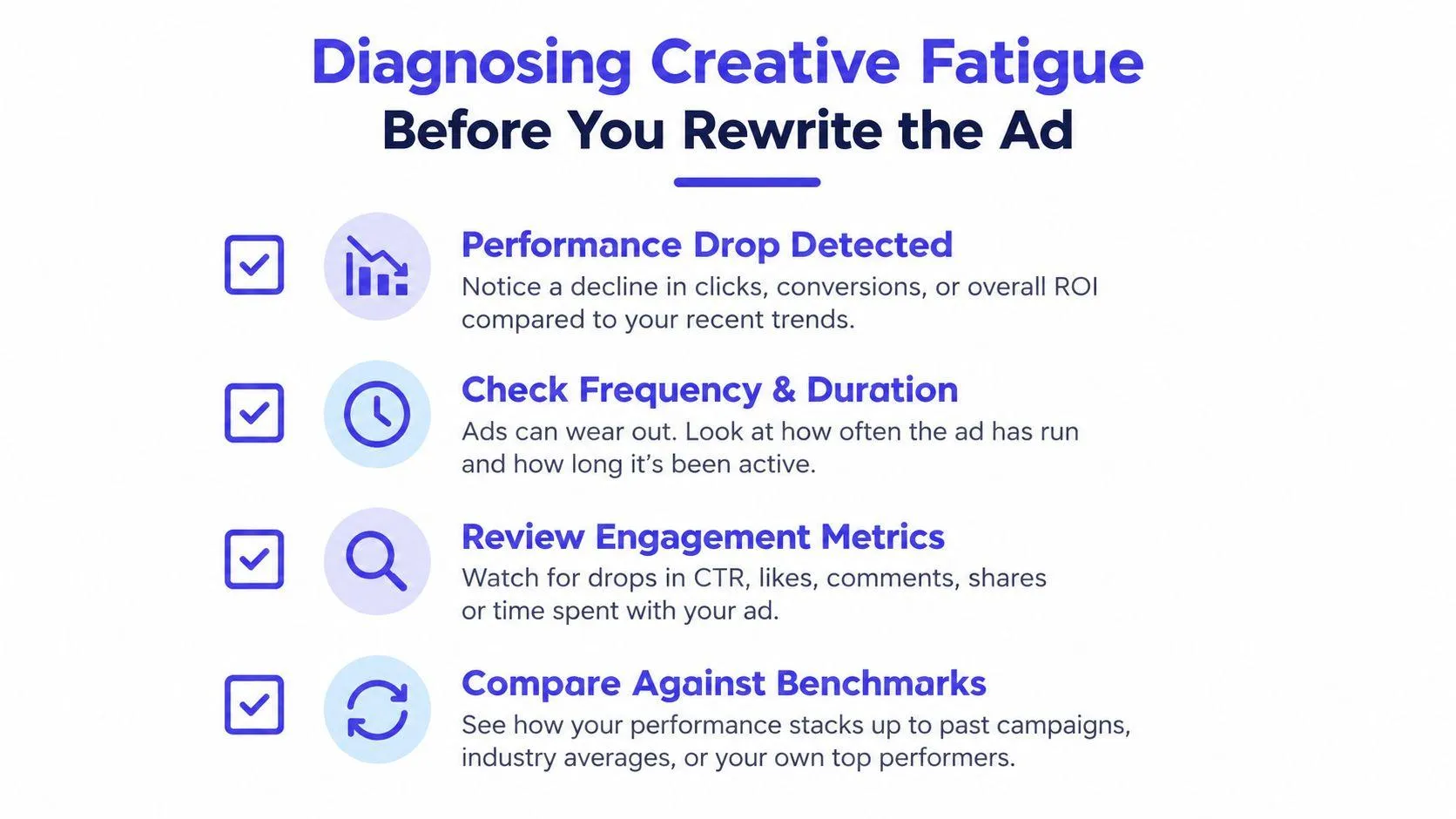
Separate attention from completion
Kantar data summarized in Marketing Interactive’s coverage of marketing trends for 2025 shows that the share of people globally saying social-media ads capture their attention fell from 43% to 31%. That’s context for taking attention seriously, not proof that your particular ad has worn out.
Diagnose the account’s evidence instead:
- Response falls while downstream quality holds: Investigate message repetition and creative fatigue.
- Visits hold but completions fall: Inspect the destination, offer conditions, and completion process.
- Costs rise without a similar response decline: Review delivery and audience conditions before blaming the wording.
- Several different messages struggle: Reconsider the offer or audience fit rather than endlessly rewriting hooks.
These are investigative paths, not automatic diagnoses. Compare placement-level results and check whether tracking or page behavior changed before drawing conclusions.
Refresh a dimension, not the whole campaign
Preserve the underlying promise while testing a new problem frame, piece of proof, audience context, objection, or CTA. If a winning ad emphasizes avoiding poor drafts, a refresh could emphasize giving the assistant missing context. That changes the reason to care without inventing a new product benefit.
Don’t replace the copy, visual, offer, and landing page together and then claim you fixed copy fatigue. You may improve the campaign, but you won’t know which change helped.
Keep a winning ad as a comparison while you test the refresh. Otherwise, you’re comparing a new message with your memory of the old one.
Refresh cadence should follow evidence and production capacity. A small team doesn’t need to imitate a high-volume advertiser’s publishing schedule. It needs a clear record of what changed, why it changed, and whether qualified results improved.
The One-Page Checklist and Three Copy Prompts You Can Reuse
A reusable prompt should preserve your decisions, not ask an assistant to invent them. Supply the product truth, audience, objective, approved evidence, and prohibited claims before asking for copy.
Keep this checklist beside the drafting window.
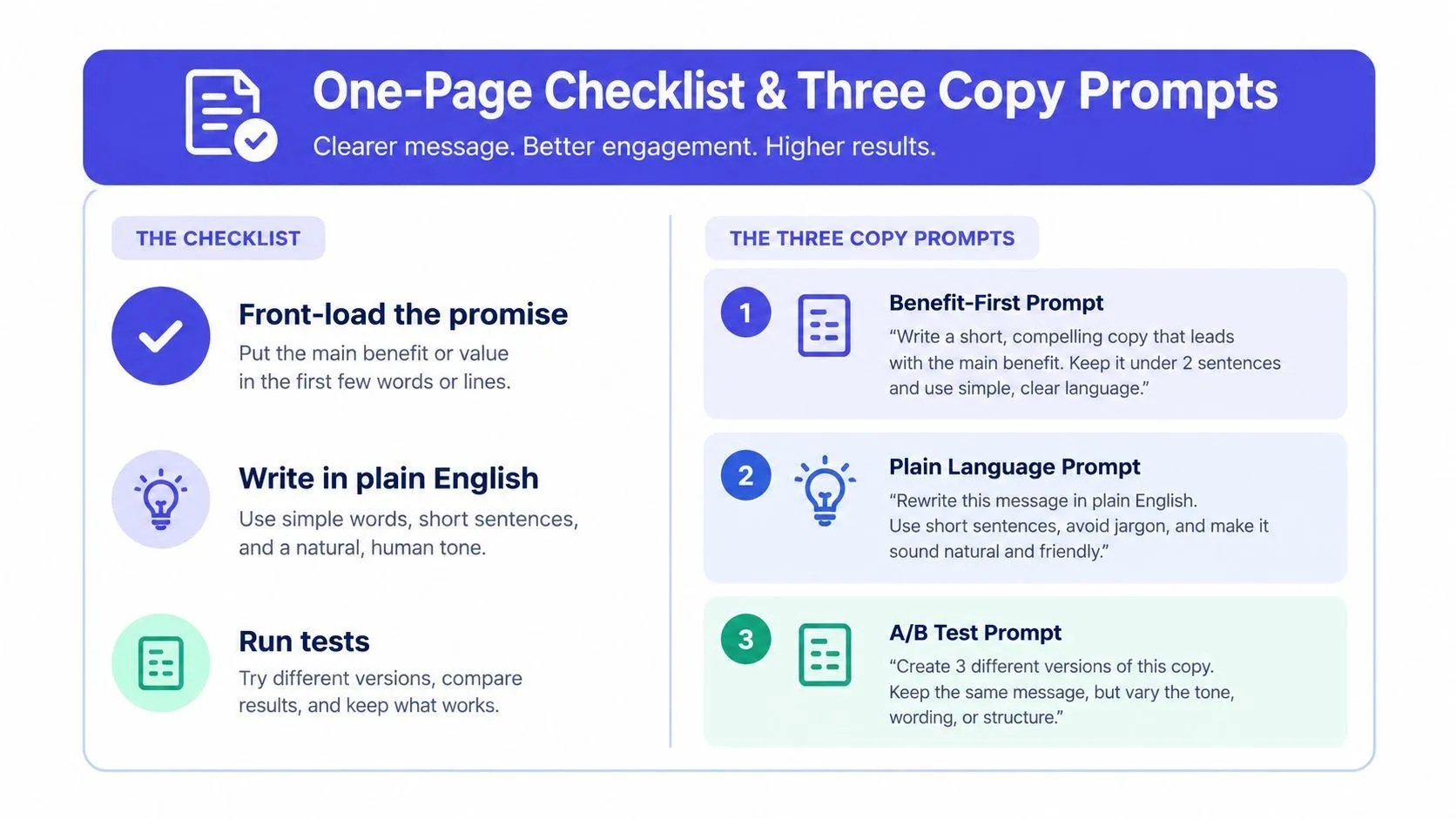
Prelaunch checklist
- Meaning: Can the reader identify the offer from the visible opening?
- Language: Have you removed jargon, filler, and borrowed excitement?
- Truth: Can you support every product claim and reassurance?
- Destination: Does the page deliver what the CTA promises?
- Rendering: Have you checked each intended placement?
- Experiment: Is the copy variable isolated, with adequate budget and a defined evaluation rule?
- Review: Has a person checked any AI-assisted draft?
- Refresh: Can you explain what changed without listing the whole campaign?
Use ad copy generator guidance to choose a drafting workflow, but keep judgment with the person responsible for the offer.
Benefit-led variant prompt
Write benefit-led Facebook ad copy for [product] aimed at [audience]. The offer is [offer], and the desired action is [action]. Use only these facts: [approved facts]. Explain how the product works. Use plain English, avoid inflated claims, and flag missing information before drafting.
Objection-handling prompt
Write Facebook ad copy addressing [specific objection] for [audience]. Use this verified response: [evidence or product detail]. Acknowledge the concern without exaggerating it. Give the reader a clear next step. Don’t invent testimonials, guarantees, scarcity, or results.
Fatigue-refresh prompt
Review this current ad: [copy]. Its established angle is [angle], and the performance concern is [evidence]. Suggest refreshes that change only [problem framing, proof, objection, audience context, or CTA]. Preserve the offer and approved claims. Explain the hypothesis behind each draft.
Choose a prompt, fill in the evidence, and reject drafts that add unsupported persuasion. Save the approved copy with its hypothesis and test conditions. That record is more useful than a folder full of unexplained winners.
Prompt Like A Pro is a free web app that asks focused questions about your task and builds a structured prompt for your chosen AI assistant, without an account or server-side prompt storage. Visit Prompt Like A Pro with your offer, audience, and approved claims to build a clearer Facebook ad-copy brief before launching your next controlled test.
Ready-made prompts for this
Build yours with the wizard
Prompt Like A Pro asks a few questions about your task, then writes a complete prompt for ChatGPT, Claude or Gemini. Free, no signup.
Make a prompt →Read next
10 Ad Copy Generator Tools Compared: Strengths and Pricing
Ten ad copy generators compared on what happens after the first draft: brand control, scoring, workflows and pricing, with who each tool suits.
Read the guide →