
Bullet Points Format That Actually Works
You’re staring at a list that should be helping, but it’s doing the opposite. The bullets are long, the grammar keeps shifting, and the point you needed is buried halfway down the page. That’s when bullet points format stops being a cosmetic choice and starts deciding whether your reader understands you at all.
A good list doesn’t just look neat. It forces you to separate one idea from the next, cut the noise, and make the shape of the page do some of the thinking for you. That’s why the best bullet lists feel clean even before they feel persuasive. They make hard reading easier because the writer has already done the hard thinking.
Table of Contents
- Why Your Bullet Lists Are Harder to Read Than They Should Be
- Orwell’s Six Rules Applied to Bullets
- The Anatomy of a Bullet That Earns Its Place
- Sentence Form Versus Phrase Form as a Working Choice
- Bullet Points Format Across Real Platforms
- A Final Checklist and a Draft You Can Copy
Why Your Bullet Lists Are Harder to Read Than They Should Be
A lot of bad lists begin with good intentions and end in fatigue. A reader opens a product page with twelve bullets, or a meeting recap packed with dense lines, and every item runs three lines long, mixes two or three ideas, and starts with a different kind of phrase. By the fourth bullet, the eye is working harder than the brain should have to.
Three failures show up again and again. First, there’s a wall of bullets with no hierarchy, so every item feels equally important. Second, the bullets mix levels of abstraction, one line gives a feature, the next gives a policy, the next gives a vague promise. Third, the bullets hide the point inside sentence fragments, so the reader has to guess what the writer means.
Practical rule: A bullet should make one point visible fast, not force the reader to decode a paragraph in disguise.
That’s why bullet points format is really a thinking tool. You’re not decorating finished prose. You’re deciding what deserves its own line, what should be grouped, and what should be cut. If you write the whole paragraph first and then smash it into bullets, the list usually keeps the paragraph’s confusion.
When writers use lists well, they separate ideas before they stylize them. That discipline matches the same plain-prose habits George Orwell argued for in Politics and the English Language, and it also fits the structural rules readers respond to in research on bullet lists. A clean shape with clean language earns its place. A messy shape with messy language just makes the page longer.
If you want a simple editing pass for clarity, this clear-and-concise text editor prompt can help you strip a draft down before you format it.
Orwell’s Six Rules Applied to Bullets
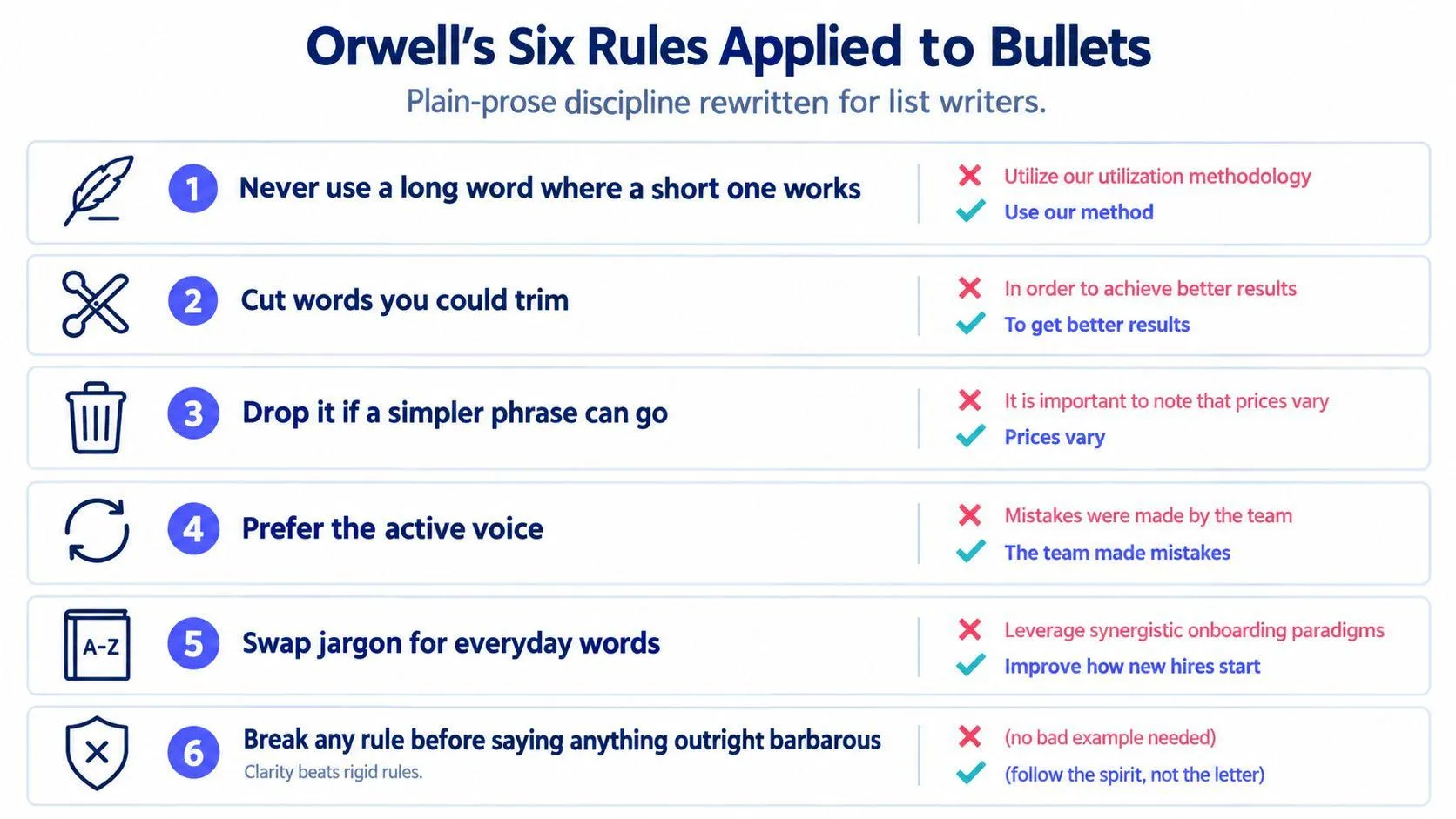
Orwell’s rules work on bullets because bullets magnify weak writing. A vague phrase that might pass in a paragraph looks sloppy once it sits on its own line. The fix is not fancy. It’s usually shorter words, fewer filler phrases, and a cleaner sentence shape.
Keep the words plain
Orwell’s first two rules are a good starting pair, choose the short word and avoid stale phrasing. A bullet like “Utilize our utilization methodology” sounds inflated and dull. “Use our method” says the same thing without the ballast.
Cut what does not carry meaning
The next habit is ruthless trimming. “In order to achieve better results” wastes space on a lead-in the reader doesn’t need. “To get better results” gets to the point at once. The same rule applies to anything you could delete without changing the meaning.
Prefer the active voice and everyday words
Bullets get weaker when nobody is clearly doing the action. “Mistakes were made by the team” hides responsibility. “The team made mistakes” names the actor directly. The same goes for jargon, “Use synergistic onboarding models” may sound impressive to the writer, but “Improve how new hires start” is readable to everyone.
Break the rule before you break the reader
Orwell’s final rule matters because clarity beats obedience. If a sentence turns barbarous when shortened, don’t force it into a bad shape. But treat that as an exception, not the default.
Bottom line: these are the minimum standards for every bullet, not optional polish.
The Anatomy of a Bullet That Earns Its Place
The first structural question is size. Bullet lists are easier to scan when they stay within 5 to 7 items, and the reason is cognitive load, not taste. Guidance on bullet formatting notes that going past 7 items is associated with a 30% drop in skimming efficiency because readers have more to hold in mind at once. The safe move is to split longer material into grouped sublists instead of piling everything into one stack. Practical bullet formatting guidance
One idea per bullet
A stuffed bullet tries to do too much.
Weak: “Onboard new hires, set up accounts, and schedule training for the first month.”
That line contains three actions, so the reader has to unpack the list before understanding it.
Break it apart.
Stronger: “Onboard new hires.”
Stronger: “Set up accounts.”
Stronger: “Schedule first-month training.”
The research on bulleted lists matters. Bullets help readers remember the items themselves, but they can pull attention away from the surrounding prose if you mix too many ideas together. A separated list keeps each item clean while the nearby sentences carry the context.
Parallel grammar keeps the list steady
A list reads faster when each line starts in the same grammatical shape.
Weak: “Launch the campaign, budget approved, tracking results, and customer feedback reviewed.”
Stronger: “Launch the campaign.”
Stronger: “Approve the budget.”
Stronger: “Track results.”
Stronger: “Review customer feedback.”
The pattern matters because the eye learns what to expect. If every bullet begins differently, readers keep reorienting. If every bullet follows the same shape, they move.
Nested bullets need a reason
Indenting can help when a main idea needs two or three supporting details, but nested lists should stay shallow. The ONS style guidance warns that structure choice matters, and inconsistency makes bullets harder to trust. Use nesting when the parent item is clearly the headline and the child items are subordinate. If the subpoints start competing with the main point, flatten the list.
| Context | Weak Bullet | Strong Bullet |
|---|---|---|
| Project update | Managed launch, feedback, and fixes. | Launched the release. |
| Policy summary | Employees must follow the new remote work policy carefully. | Remote work now requires manager approval. |
| Feature release | Added search, speed improvements, and a cleaner dashboard. | Added faster search. |
If you’re rewriting duties into outcomes, this resume bullet prompt is a useful structure to borrow from.
Sentence Form Versus Phrase Form as a Working Choice
The sentence-versus-phrase question isn’t a style war, it’s a working decision. A bullet can stand alone as a full sentence, or it can act as a phrase that depends on the lead-in above it. The right choice depends on where the list lives and what the reader needs from it.
Two forms, two jobs
A sentence-form bullet can stand by itself.
Example: “The team approved the draft before noon.”
A phrase-form bullet leans on a lead-in.
Example: “Approved before noon”
The first form is safer when the bullet may be copied, quoted, or read out of context. The second is often cleaner when the list sits under a strong introductory line and the reader already knows the topic.
| Context | Recommended Form | Weak Example | Stronger Rewrite |
|---|---|---|---|
| Academic writing | Sentence form | “Need better sourcing” | “The paper needs better sourcing.” |
| Web content | Phrase form | “We improve workflow with speed and clarity” | “Faster workflow, clearer output” |
| Product pages | Mixed, with consistency | “It saves time. Fast setup. Easier to use.” | “Saves time.” / “Fast setup.” / “Easy to use.” |
| AI prompts | Phrase form | “Please analyze the following, and then summarize the main ideas in a helpful way” | “Analyze the text. Summarize the main ideas. Keep it concise.” |
Match the form to the job
Academic writing usually expects full sentences, and phrase fragments can look careless. Web content is different. Readers skim, so phrase form often scans faster, especially when you pair it with bold lead-ins. Product pages can use mixed forms if each bullet carries one benefit and one piece of evidence, but the structure has to stay consistent. AI prompts benefit from consistent phrasing because the model can parse the intent more easily when the instruction shape doesn’t keep changing.
Decision rule: use sentence form when the bullets must stand alone, and phrase form when the list has a clear lead-in the reader is already tracking.
Bullet Points Format Across Real Platforms
A bullet list is a small tool, but the job changes with the surface. On a marketplace page, a slide, a blog post, or an AI prompt, readers expect different things from the same visual shape. Good bullet points format follows the channel first, then the sentence.
Amazon product bullets need discipline
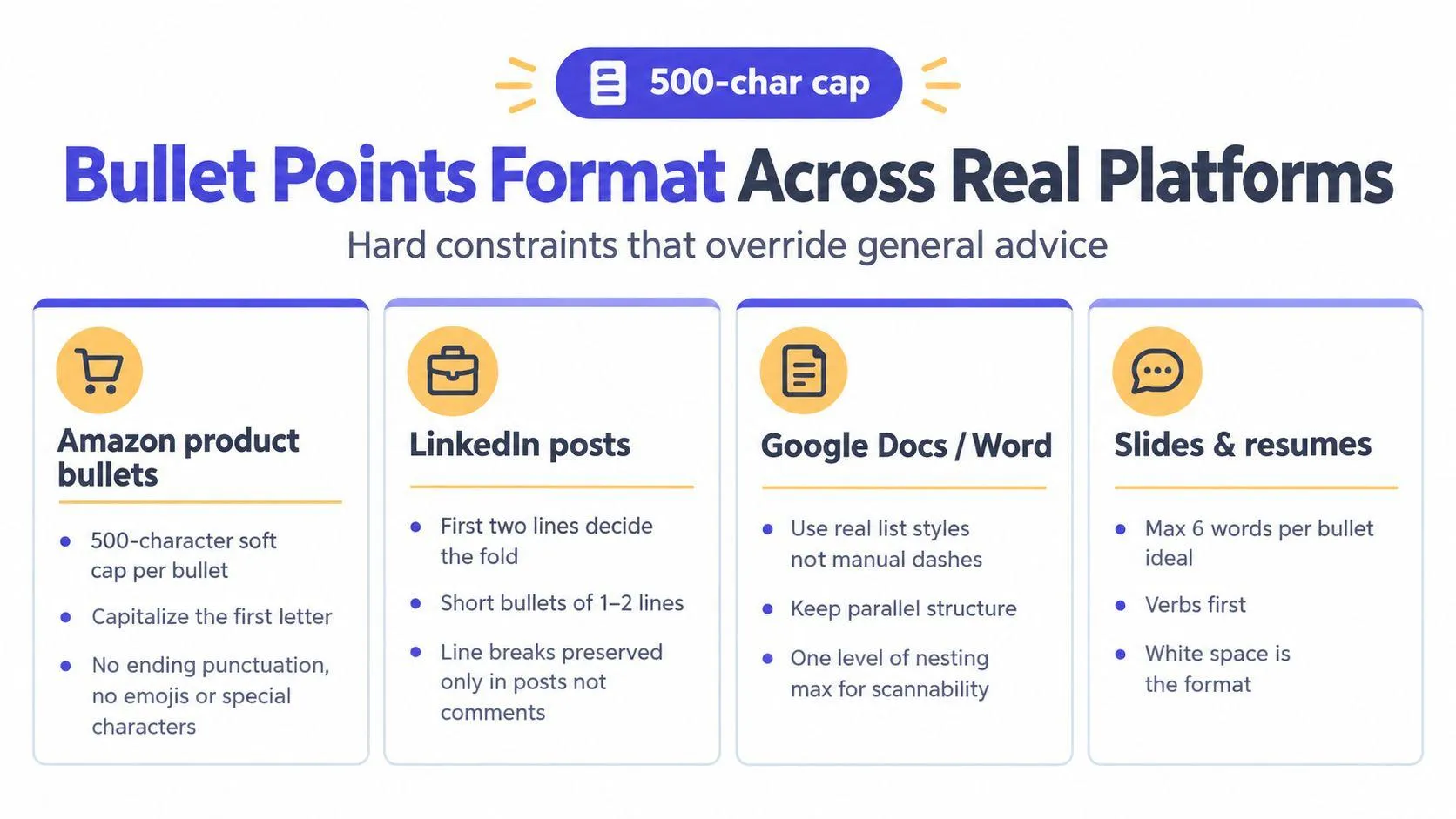
Amazon product bullets reward rigid structure. Keep each bullet under the platform’s 500-character soft cap, start with a capital letter, avoid ending punctuation, and lead with the benefit rather than the feature. A feature-led line such as “Includes stainless steel blades” becomes stronger as “Slices food quickly with stainless steel blades” because the reader sees the payoff first.
Web content wants skimmable anchors
In blog posts and SEO pages, bullets work best as summaries, pull-quotes, or TL;DR anchors. Bold the lead-in when it helps the eye land on the point fast, but do not turn every line into a slogan. Put keywords near the front when they belong there, yet keep the line natural. The reader should be able to glance, understand, and move on.
Slides and prompts need even tighter shape
Slides should rarely carry long bullets. If a slide must use them, keep them short and sparse, because the slide supports the speaker rather than competing with them. AI prompts work differently, because the bullet structure often guides the response structure. A loose paragraph often produces a looser answer. Short, parallel bullets give the model a cleaner map to follow.
If you are drafting bullets for an AI prompt, write each instruction as its own short imperative line so the model can map instructions to output sections one by one.
A Final Checklist and a Draft You Can Copy
A strong list is usually the result of four passes, not one. First you trim the language. Then you shape the structure. Then you check the platform. Then you read it aloud and see where the rhythm breaks. That workflow keeps bullet points format tied to revision, which is where most good lists are made.
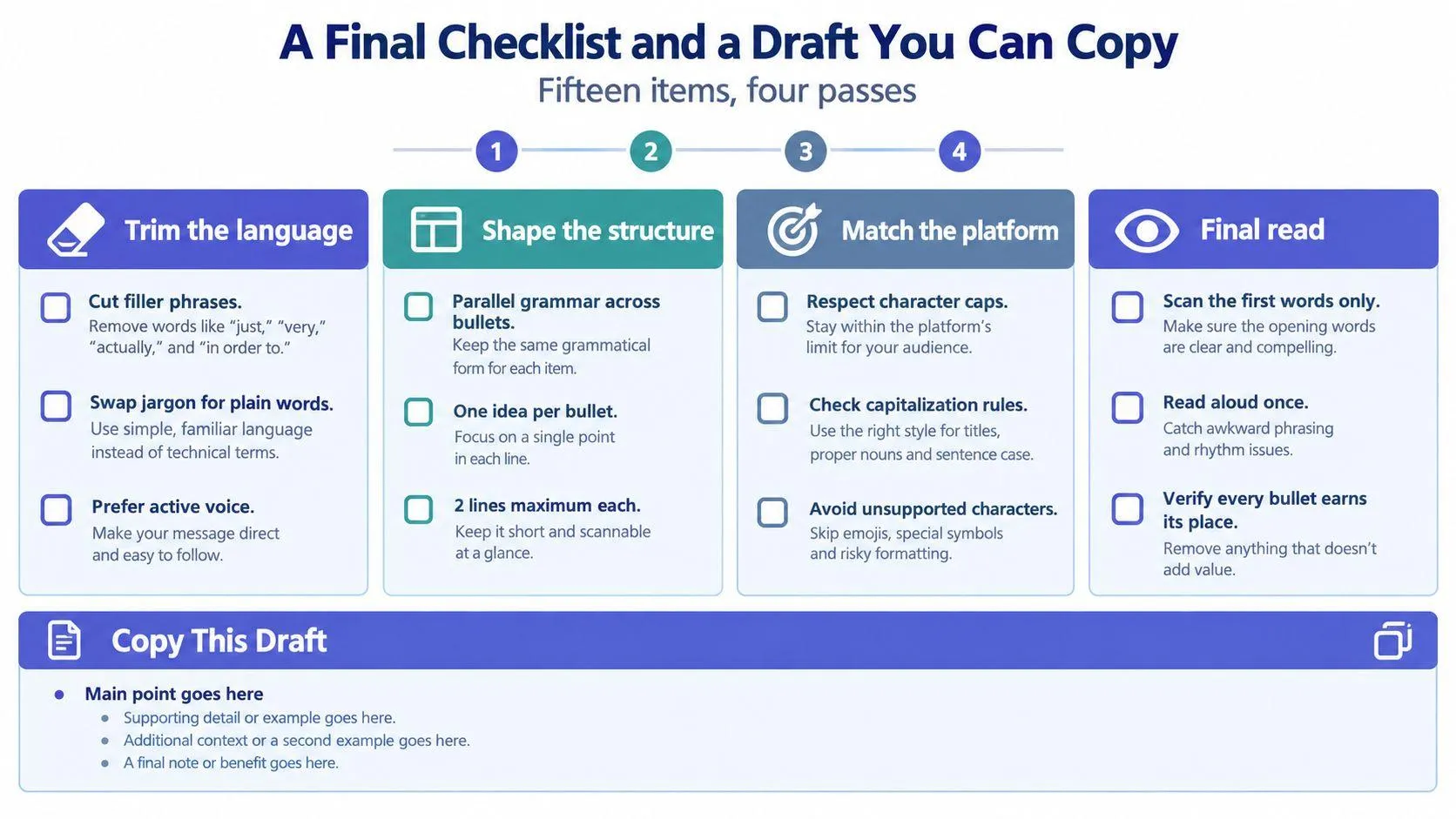
The fifteen-item checklist
- Cut filler words immediately.
- Replace jargon with plain words.
- Prefer active verbs.
- Delete anything that doesn’t change meaning.
- Give each bullet one idea.
- Keep grammar parallel across the list.
- Limit nesting to what the reader can track.
- Keep each bullet short enough to scan.
- Choose sentence form when bullets must stand alone.
- Choose phrase form when the lead-in carries the context.
- Match platform rules before publishing.
- Check capitalization and punctuation rules.
- Scan the first words only.
- Read the list aloud once.
- Ask whether every bullet earns its place.
Rough draft and finished list
| Rough draft | Finished list |
|---|---|
| Managed the launch, updates, and customer communication in order to improve the product experience. | Launched the product. |
| Really helped the team with onboarding and training. | Trained new hires. |
| Responsible for making the workflow more efficient. | Improved the workflow. |
| Worked on feedback, bugs, and reporting so the release would be better. | Fixed bugs. |
| Very important to keep stakeholders informed. | Sent stakeholder updates. |
The rewrite does three things at once. It cuts filler like really, very, and in order to. It turns feature-speak into plain action. It also narrows each bullet to one job so the reader doesn’t have to sort out mixed intentions.
That’s the point worth keeping. Bullet points format isn’t a template you copy once and forget. It’s a habit of revision, shaped by Orwell’s plain prose and by the way readers scan, compare, and decide.
Prompt Like A Pro helps you turn a messy task into a structured prompt by asking the right questions before it writes anything. If you want cleaner prompts, clearer outputs, and a format that fits the AI assistant you’re using, visit Prompt Like A Pro and try it on your next draft.
Build yours with the wizard
Prompt Like A Pro asks a few questions about your task, then writes a complete prompt for ChatGPT, Claude or Gemini. Free, no signup.
Make a prompt →